
ATMs in the UK: locations, tips, and fees

By the end of 2025, the UK had 42,403 cash machines, with 33,710 letting you take out money for free and 8,693 charging a fee on your withdrawal. These figures mean that while finding a machine is statistically easy, your chances of getting hit with a fee or hitting a tight daily withdrawal limit depend entirely on the specific street you are standing on and the bank you use. This guide shows you how to track down the machines that will not charge you, how to spot hidden costs before you insert your card, and what other options you have when the local ATM is either out of reach or trying to take a cut of your money.
ATM landscape in the UK
For more guides check:
(1) ATMs in the EU,
(2) ATMs in Ireland,
(3) ATMs in Germany,
(4) ATMs in Sweden.
Whether you’re on holiday, commuting for work, or simply running errands, understanding your options can save you unnecessary transaction fees and help you spot fee-free alternatives. By the end, you’ll know exactly where to turn for free ATM UK usage, how to dodge the dreaded currency trap, and which networks offer the lowest banking fees. Ready to demystify the world of cash machines in the UK? Let’s begin.
Number and locations of cash machines
By the end of 2025, there were 42,403 cash machines (Link.co) in the UK, yet that figure hides uneven regional coverage. Major urban areas boast multiple options within a few minutes’ walk, while rural access can be sparse—sometimes leaving villagers with only a single post office ATM or a convenience store machine.
To pinpoint the nearest device, use LINK’s Cash Locator or your bank’s app. Many banks also publish interactive maps that reveal standalone kiosks, supermarket lobby ATMs in the UK, and machines tucked inside petrol stations.
Tip: map out cash machines in the UK before embarking on cross-country trips, and always note any nearby post office ATM as a reliable backup.
Explore: the cost of living in the UK in 2025
ATM and card networks
Nearly 100% of ATMs in the UK run on the LINK network, which means you can walk up to nearly any machine and pull out money using your normal bank account. If you are visiting from abroad, you just need to glance at the stickers on the machine—if it shows Visa, Plus, or Mastercard, your card will work fine.
When your local high street bank closes down, that is where Cash Access UK comes in. They set up shared Banking Hubs and alternative cash desks in towns where traditional branches have disappeared, so you still have a place to go when you need physical notes.

Understanding fees
UK ATM withdrawal fee breakdown
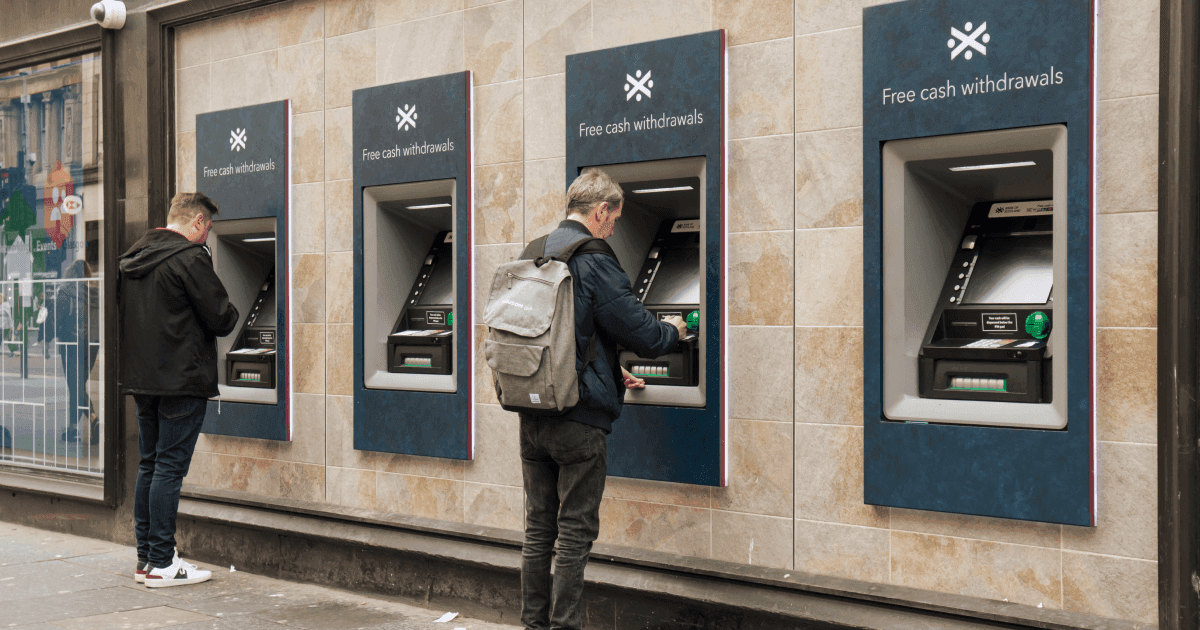
At the end of 2025, 33,710 of the UK’s 42,403 cash machines were free to use, while 8,693 charged customers for withdrawals. UK cash machines clearly show whether they are free or will charge you a fee. If there is a charge, the machine has to tell you the exact amount on the screen before it takes your money, so you can always cancel the transaction if you do not want to pay it.
Remember that the ATM operator’s fee is only one part of what you might pay. Your own bank can also charge you for pulling out cash, especially if your card comes from outside the UK. These foreign withdrawal and conversion fees usually take about 2% to 3% right off the top of what you withdraw. Some banks skip the percentages and charge a flat fee instead, set minimum and maximum limits on the penalty, or only give you a few free withdrawals before the charges kick in.
To see how quickly these costs add up, you only have to look at what UK banks charge their own customers when they travel abroad.
- NatWest takes 2.75% of your money
- Barclays takes 2.99%
- HSBC charges 2%, but they add a minimum charge of £1.75 and cap it at £5.
While these specific numbers show how banks structure their fees, the exact amount you will lose at a UK cash machine entirely depends on the contract you have with your own bank back home.
Using a credit card at an ATM is almost always a bad idea. Banks usually slap a cash-advance fee of around 3% on the transaction, and most will charge you a minimum of about £3 just for inserting the card. HSBC, for instance, takes 2.99% with that same £3 minimum. The real trap, though, is the interest—unlike standard purchases where you get a grace period to pay off your balance, credit card cash withdrawals start racking up interest the exact second the notes leave the machine.
Card charges and monthly limits
Apart from per-transaction fees, some accounts levy a flat monthly charge for free withdrawals: you might pay a little bit in exchange for unlimited UK ATM withdrawal fees waivers.
Certain premium accounts advertise “no foreign card charges in the UK,” but beware: that often covers only partner-network machines. If you’re using an international card, expect both the host ATM’s surcharge and your own issuer’s fee. Typical card charges in the UK range from 2% to 3% of the transaction value on debit cards and credit cards. To minimise this, use multi-currency travel cards or specialist providers with zero foreign transaction fees.
Monthly ATM limits in the UK also vary. Standard current accounts tend to cap free withdrawals at £300 per rolling day. Premium or packaged accounts often double that or remove limits entirely. If you require more than £600 a day in cash—say, for a pop-up market stall or charity collection—seek out accounts with higher or no caps.
Tips for minimising costs
Using free ATMs and post office options
One of the simplest cost-cutting strategies is to seek out free ATM UK options. Major high-street chains—NatWest, Barclays, Lloyds—offer unlimited free withdrawals for their own customers at in-branch machines.
If you cannot find a standard cash machine nearby, you can walk up to the counter at most Post Offices and withdraw money using your normal debit card and PIN. The Post Office itself will not charge you a penny for doing this, which is a massive relief if you are stranded in a small village. However, you still need to keep an eye on your own bank's rules, as they might apply their own daily limits or transaction fees behind the scenes. You might also notice a cash machine sitting outside or inside the Post Office building. While these specific ATMs are usually free to use, they are run on a completely different system from the service you get at the counter—so do not confuse the two when you are checking your options.
- How to find ATMs and Post Office branches
To find a cash machine quickly, check LINK’s Cash Locator which maps out every machine near you. The Post Office branch finder shows you the nearest location where your debit card will work.
Also, check supermarket forecourts: Sainsbury’s, Tesco and Morrisons often host no-fee ATMs in their petrol station lobbies. Always compare your bank’s in-network map with third-party listings; sometimes, you’ll find cash machines in the UK that are free for all comers, even if it’s not in your bank’s alliance.
Best money exchange strategies
When you need foreign currency, avoid airport bureaux de change with punishing spreads and service charges. Instead, use the best money exchange UK providers online that post competitive rates and deliver to your door for free. Pre-order before you travel and collect at a local branch, or have it shipped to your UK address to dodge the notorious currency trap within tourist zones.
Alternatively, if you have a sterling account with no-fx-fee travel cards, withdraw local currency abroad using free-network ATMs (e.g., Global Alliance). The combined effect of low exchange rate margins and zero overseas ATM fees can beat high-street bureaux by 1–3%.
Remember to tally any home bank banking fees: occasionally, a small percentage fee at home plus a foreign ATM network surcharge still undercuts the poor rates at physical exchange kiosks.
Special considerations
Rural access and safety
Venturing into less populated areas highlights the importance of rural access planning. Always map out cash machines in the UK ahead of time, and check whether village shops or farms have independent post office ATM facilities. Lack of choice can mean higher surcharges or even no service in emergencies.
Safety is equally vital. Use machines located inside brightly lit premises rather than standalone roadside kiosks, which can attract fraudsters. Inspect the card slot for tampering, cover your PIN entry, and never accept “help” from strangers during transactions.
Banking Hubs and alternative cash services
If there is no bank branch or ATM nearby, you might find a Banking Hub in your area instead—in 2026 there are 280 of them across the UK. These are shared spaces set up in towns where high street bank branches have completely disappeared, ensuring people can still handle their money face-to-face.
The buildings belong to Cash Access UK, but the staff at the main counter work for the Post Office. Depending on who you bank with, you can usually walk up to the counter to:
- withdraw cash;
- pay notes and coins into your account;
- deposit cheques;
- see how much money you have left in your account;
- settle your utility bills;
- top up your prepaid gas and electricity keys;
- get physical change for your business if you are registered.
You can locate your nearest shared space on the Cash Access UK website, or use LINK’s Cash Locator to see how they compare with nearby ATMs and standard Post Office branches.
ATM withdrawal limits
Every machine and network enforces ATM limits in the UK, restricting both daily and single-transaction caps. The usual range is between £250 and £1,000. Check with your provider: if you anticipate needing more—perhaps you’re purchasing high-value items or funding an event—request a temporary limit increase.
Be aware that exceeding even a single-transaction cap can force you into multiple ATM withdrawals, each potentially incurring separate transaction fees. If you need £600, withdrawing £300 twice may cost more than a single £600 transaction where permitted. Plan ahead: spread your larger withdrawals over consecutive days if necessary, or seek premium accounts that waive ATM fees altogether.
Conclusion and final thoughts
Mastering ATMs in the UK means balancing convenience, cost, and security. By understanding UK ATM withdrawal fees, choosing the right alliances, and embracing fee-free and post-office ATM alternatives, you’ll reduce unnecessary card charges in the UK and dodge the currency trap. Plan your withdrawals around monthly ATM limits in the UK, leverage smart finance tools to monitor your rolling month usage, and seek out the best money exchange UK options for overseas cash. Whether you’re tapping into urban clusters of cash machines in the UK or braving remote corners, these insights ensure you keep hold of your hard-earned pounds. Safe travels, savvy savers—treat your money wisely and send money from the UK with Profee.