
German recipes terms explained in English

Cooking from German recipes gets much easier once you know that Schmand is a thick soured cream, anbraten means frying something until browned, and Umluft is the fan setting on your oven. To save your next dinner, we've collected the German cooking vocabulary you'll come across in most recipes. So, if you've ever searched for "recipe deutsch" to find a local version of a favourite dish, this guide will help with the instructions.
Flour and baking ingredients
Quark, Schmand and other dairy products
Meat, vegetables and spices
Frying, boiling and baking
German kitchen equipment and appliances
German recipe measurements and abbreviations
FAQ: German recipes
Flour and baking ingredients
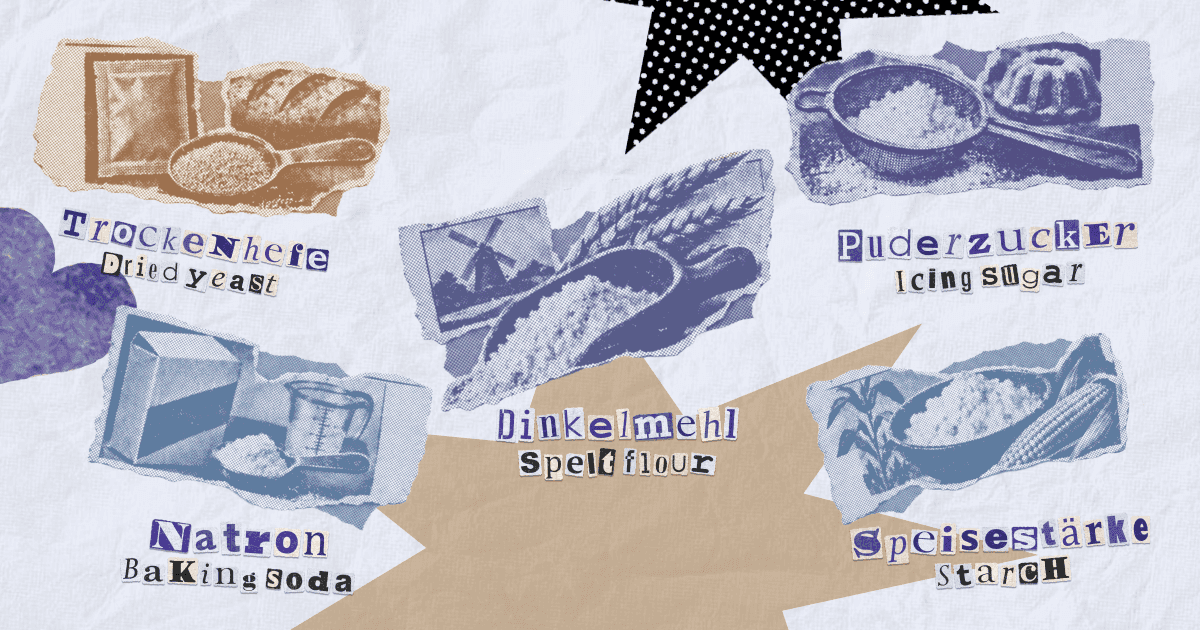
German baking recipes use several types of flour, yeast and sugar, all sold at supermarkets such as REWE, Edeka, Lidl and Aldi. Most baking ingredients are in the baking aisle, while fresh yeast is kept in the fridge.
| German ingredient names | English translation | What to know |
|---|---|---|
| Mehl | Flour | Check which type the recipe needs |
| Weizenmehl | Wheat flour | Types 405 and 550 are common |
| Dinkelmehl | Spelt flour | Used in bread, cakes and biscuits |
| Vollkornmehl | Wholemeal flour | Contains the whole grain |
| Backpulver | Baking powder | Helps cakes and muffins rise |
| Natron | Baking soda | Used in recipes with acidic ingredients |
| Speisestärke | Starch | Often corn starch, for thickening |
| Frische Hefe | Fresh yeast | Usually sold in refrigerated cubes |
| Trockenhefe | Dried yeast | Sold in small sachets |
| Puderzucker | Icing sugar | For icing and decorating |
| Vanillezucker | Vanilla sugar | Common in German cakes and biscuits |
| Semmelbrösel | Breadcrumbs | Used for schnitzel and meatballs |
If you've brought baking supplies from your home country, there's no reason to replace them all. Just check the ingredients and quantities against the German recipe, particularly for flour and raising agents.
Now, about the numbers on flour packets. Type 405, 550 and 1050 tell you how much mineral content the flour has. The higher the number, the more minerals remain after milling. For a sponge cake or biscuits, go with Type 405. Type 550 often appears in recipes for bread rolls and yeast dough, while Type 1050 gives bread a darker colour and heartier flavour.
Quark, Schmand and other dairy products
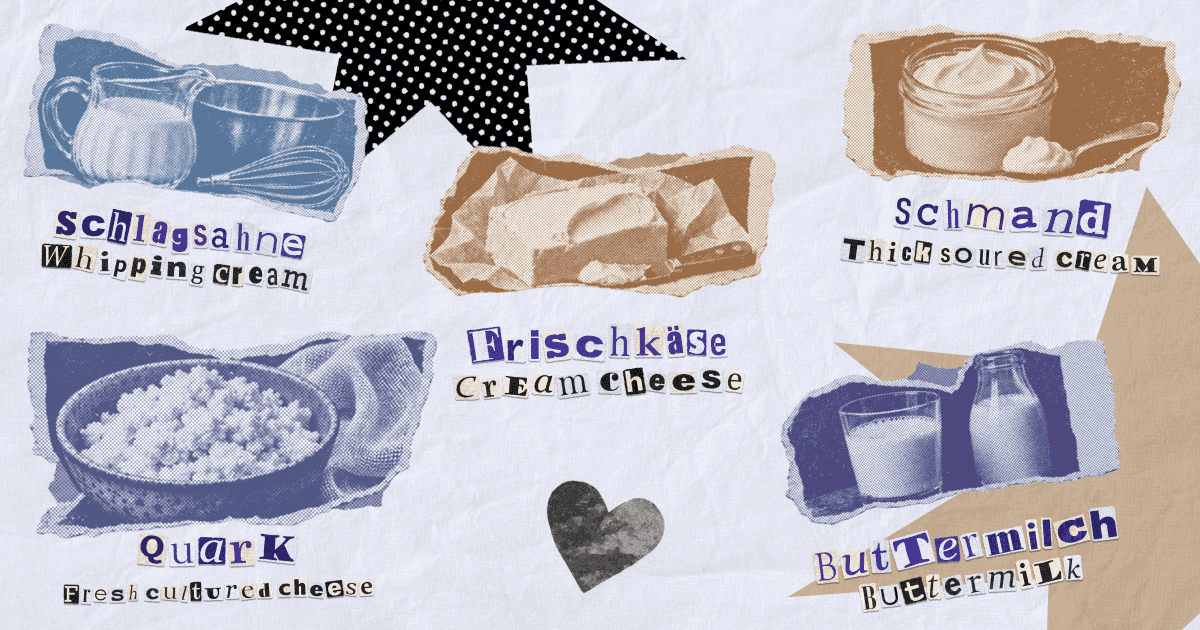
Quark is a fresh cultured cheese, Schmand is a thick soured cream, and saure Sahne is a thinner sour cream – they are three different products, despite looking rather similar. Here's how to tell them apart, along with the other dairy products you'll find in German recipes.
| German ingredient names | English / closest equivalent | Common uses |
|---|---|---|
| Quark | Fresh cultured cheese | Cheesecakes, desserts, dips |
| Magerquark | Low-fat quark | Breakfast, baking, dips |
| Schmand | Thick soured cream | Cakes, sauces, toppings |
| Saure Sahne | Sour cream | Dressings, dips, sauces |
| Schlagsahne | Whipping cream | Desserts and creamy dishes |
| Frischkäse | Cream cheese | Spreads, fillings, cakes |
| Crème Fraîche | Crème fraîche | Sauces and baking |
| Buttermilch | Buttermilk | Pancakes and cakes |
Take German Käsekuchen, for example. It's commonly made with Quark, which gives the filling a slightly tangy taste and a lighter texture than the cream cheese used in a New York-style cheesecake. Most of the ingredients are everyday supermarket products in Germany, so you won't have to hunt them down in a speciality shop.
By the way, if you're looking for a recipe to try, Allrecipes has a large collection of home-cooking ideas, including German-inspired dishes. For recipes written in German, Chefkoch is another place to browse. You can search for Käsekuchen, Kartoffelsuppe or whatever you're planning to cook.
Meat, vegetables and spices
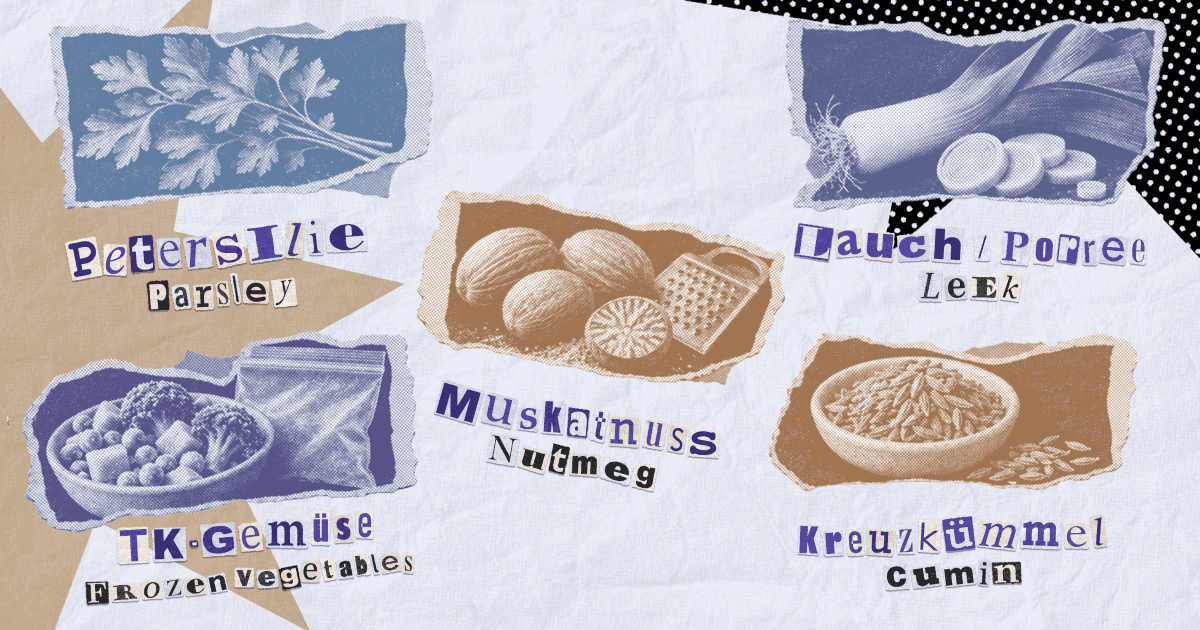
Minced meat (Hackfleisch), chicken (Hähnchenfleisch), onions (Zwiebeln) and potatoes (Kartoffeln) appear in plenty of German home-cooked meals, from meatballs to hearty soups and casseroles. You'll find these German ingredient names on supermarket labels and in recipes, along with the herbs, spices and vegetables listed below.
| German ingredient names | English translation |
|---|---|
| Hackfleisch | Minced meat |
| Rinderhack | Minced beef |
| Schweinefleisch | Pork |
| Hähnchenbrust | Chicken breast |
| Speck | Bacon or cured pork, depending on the product |
| Lauch / Porree | Leek |
| Frühlingszwiebeln | Spring onions |
| Schnittlauch | Chives |
| Petersilie | Parsley |
| Kümmel | Caraway |
| Kreuzkümmel | Cumin |
| Muskatnuss | Nutmeg |
| TK-Gemüse | Frozen vegetables |
Don’t confuse Kümmel with Kreuzkümmel. The first is caraway, often used in German bread and cabbage dishes. The second is cumin, familiar from Indian and Middle Eastern cooking. The names look related, but you'll certainly notice the difference in flavour.
The abbreviation TK stands for Tiefkühl, meaning frozen. A packet of TK-Spinat, for example, is frozen spinach from the freezer aisle.
Cutting, mixing and preparing food
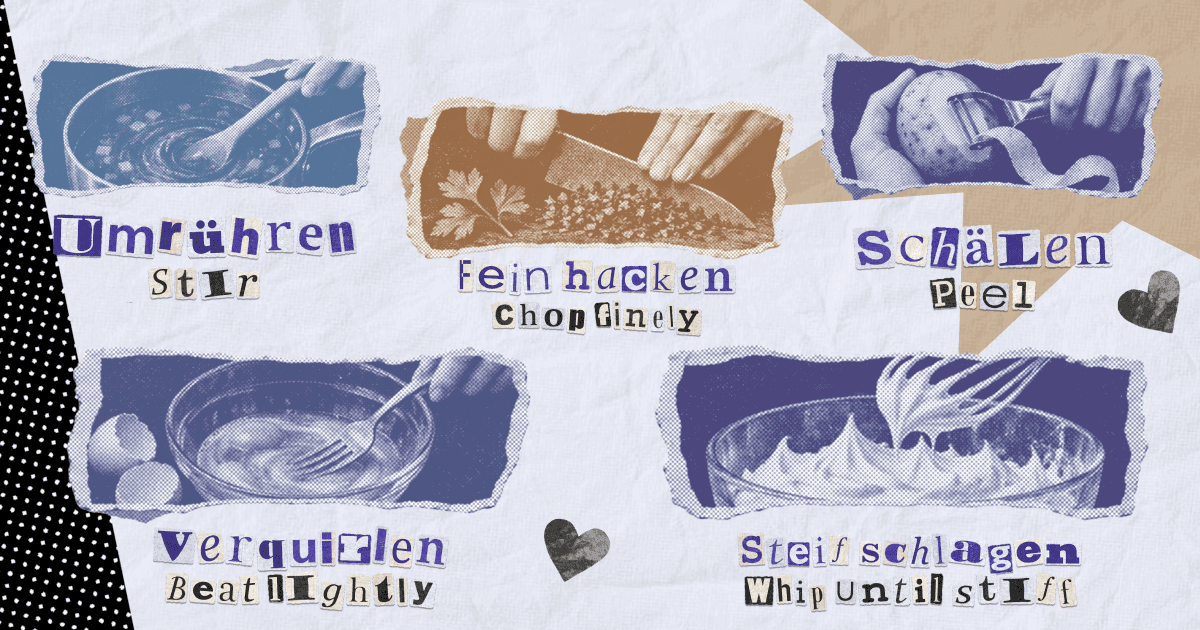
German preparation verbs cover everything from peeling potatoes to whipping cream and kneading bread dough.
| German verb | English translation | What to do |
|---|---|---|
| Schälen | Peel | Remove the skin |
| Würfeln | Dice | Cut into small cubes |
| Fein hacken | Chop finely | Cut into very small pieces |
| Reiben | Grate | Use a grater |
| Verrühren | Mix together | Combine ingredients evenly |
| Umrühren | Stir | Move ingredients around |
| Verquirlen | Beat lightly | Mix eggs or liquids |
| Unterheben | Fold in | Mix gently to preserve air |
| Steif schlagen | Whip until stiff | Often used for cream or egg whites |
| Kneten | Knead | Work dough by hand or with a mixer |
| Ausrollen | Roll out | Flatten dough with a rolling pin |
| Abtropfen lassen | Drain | Let excess liquid run off |
Some mixing instructions are there for a reason, especially when you're baking. Say you've spent a few minutes whipping egg whites, and the recipe tells you to Eischnee vorsichtig unterheben. Then, put the mixer aside and gently fold the egg whites into the batter with a spatula. Stirring them in (rühren) would undo much of that whipping, and you might end up with a rather flat cake.
Frying, boiling and baking
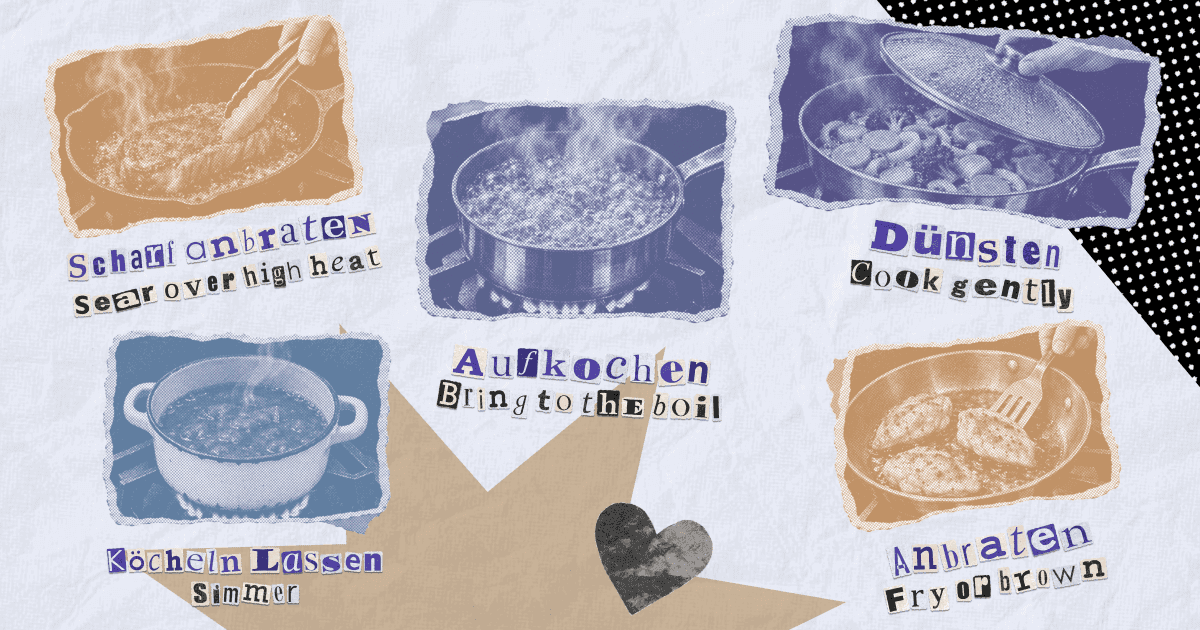
German recipes tell you whether to bring a liquid to the boil, keep it gently simmering or turn up the heat to brown meat.
| German verb | English translation | What to do |
|---|---|---|
| Aufkochen | Bring to the boil | Heat until the liquid boils |
| Köcheln lassen | Simmer | Keep the liquid gently bubbling |
| Anbraten | Fry or brown | Cook in a hot pan until coloured |
| Scharf anbraten | Sear over high heat | Brown the surface quickly |
| Dünsten | Cook gently | Use a little fat or liquid |
| Schmoren | Braise | Cook slowly with some liquid |
| Einlegen | Marinate or pickle | Leave food in a seasoned liquid |
| Vorheizen | Preheat | Heat the oven before cooking |
| Abschmecken | Taste and adjust seasoning | Add seasoning according to taste |
| Ziehen lassen | Leave to infuse or stand | Give flavours time to develop |
| Goldbraun backen | Bake until golden brown | Check the colour |
| Abkühlen lassen | Leave to cool | Allow food to cool before the next step |
One phrase deserves special attention: Fleisch scharf anbraten. Although scharf can mean spicy, here the recipe calls for high heat. So, you have to give the meat a good sear instead of covering it with the chilli powder for spiciness.
More tips for expats in Germany:
German kitchen equipment and appliances
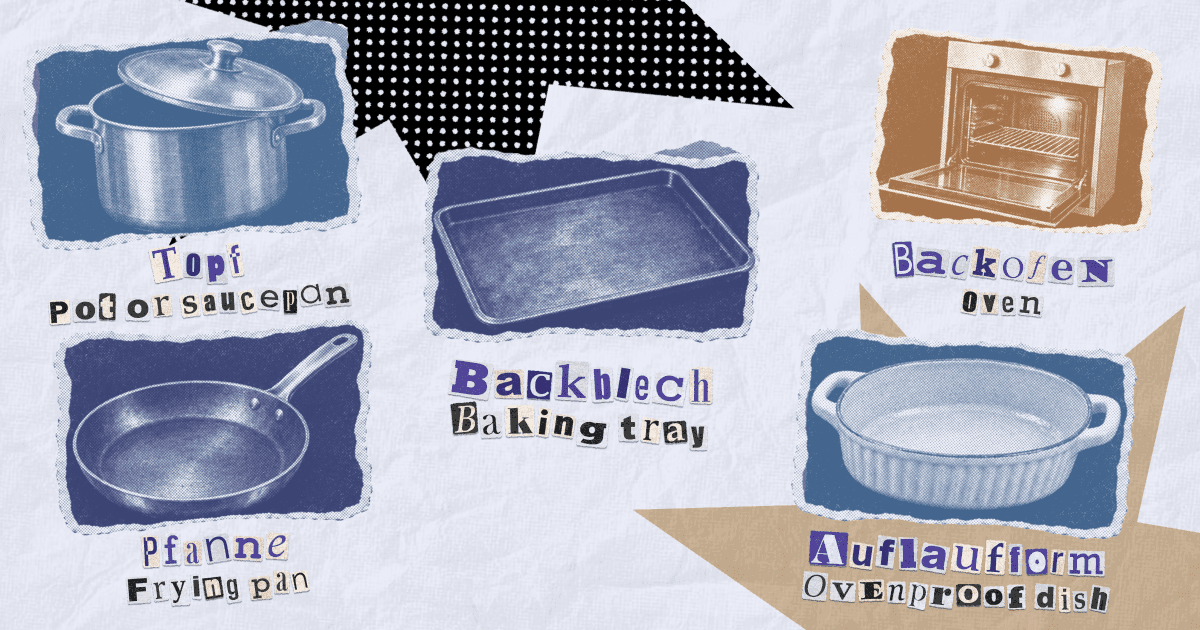
Most German recipes call for a Topf (pot), Pfanne (frying pan) or Backofen (oven), so these are good words to learn first. You’ll also need:
| German | English |
|---|---|
| Herd | Hob or cooker |
| Backofen | Oven |
| Pfanne | Frying pan |
| Topf | Pot or saucepan |
| Backblech | Baking tray |
| Auflaufform | Ovenproof dish |
| Springform | Springform cake tin |
| Schneebesen | Whisk |
| Handrührgerät | Hand mixer |
| Pürierstab | Hand blender |
| Sieb | Sieve or strainer |
| Messbecher | Measuring jug |
| Nudelholz | Rolling pin |
| Küchenwaage | Kitchen scales |
| Backpapier | Baking parchment |
Found a German recipe that your family back home might enjoy? Send it their way – perhaps they'll want to try making it for dinner. You could even treat them to the ingredients by sending money with Profee. We help you transfer money from Germany to over 90 countries, with most transfers arriving within minutes. That gives your loved ones plenty of time to plan something delicious for their next family dinner.
German oven settings: Umluft vs Ober-/Unterhitze
Umluft is the fan-assisted setting on a German oven, similar to convection heat on an English-labelled oven, while Ober-/Unterhitze heats food from above and below without a fan. Recipes often give a temperature for each, letting you choose whichever setting your oven has.
| German setting | English | What it means |
|---|---|---|
| Ober-/Unterhitze | Top and bottom heat | Heating elements above and below |
| Umluft | Fan-assisted heat | A fan circulates heated air |
| Heißluft | Hot-air setting | Air heated by a separate element and circulated by a fan |
| Grill | Grill / broil | Strong heat from above |
| Unterhitze | Bottom heat | Heat from below |
| Auftauen | Defrost | Thawing frozen food |
The recipe may also mention where the tray should go. Mittlere Schiene puts it in the middle of the oven; unteres Drittel means one of the lower positions. With cheesecake, for instance, putting the tin too high can leave you with a dark top while the middle is still undercooked.
If you're using the oven in a rented flat for the first time, keep an eye on your cake a little earlier than the recipe suggests. Even with the temperature set correctly, ovens can bake quite differently.
German recipe measurements and abbreviations
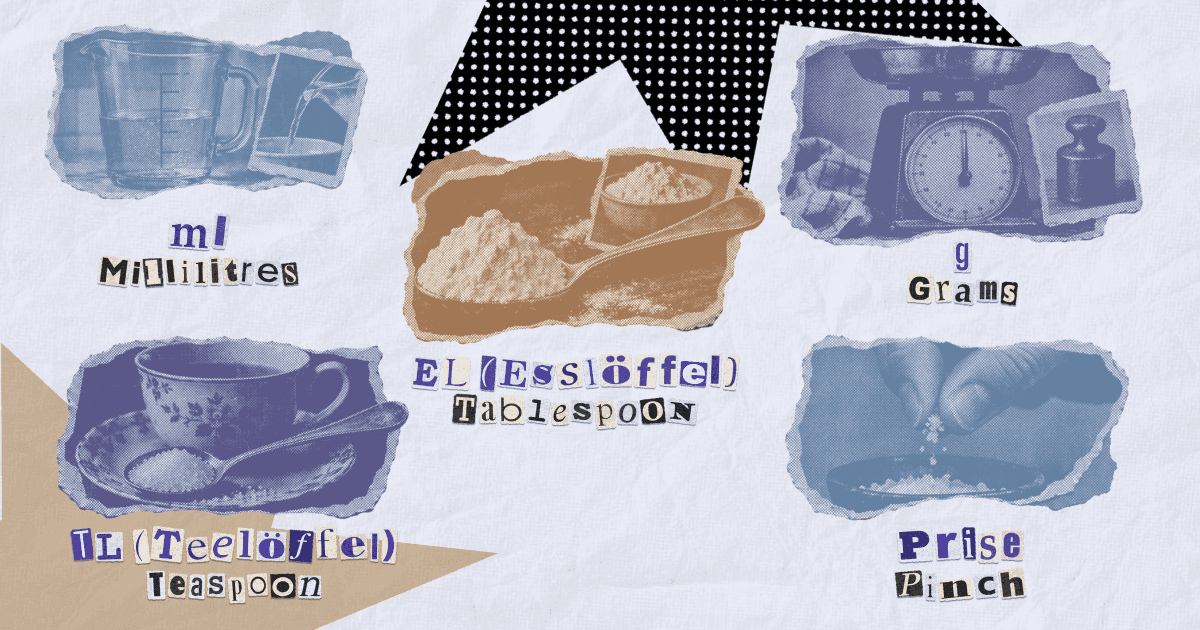
German recipes use metric measurements – grams, millilitres and Celsius. However, the shorthand in the ingredient list might take some time to get used to. A recipe might ask for 2 EL Zucker, 1 Prise Salz or 1 Pck. Backpulver. Here's how to read those quantities.
| German | English |
|---|---|
| EL (Esslöffel) | Tablespoon |
| TL (Teelöffel) | Teaspoon |
| g | Grams |
| ml | Millilitres |
| Prise | Pinch |
| Msp. (Messerspitze) | Knife-tip amount |
| Pck. / Päckchen | Packet or sachet |
| Bund | Bunch, usually herbs |
| gestrichen | Level spoonful |
| gehäuft | Heaped spoonful |
| ca. (circa) | Approximately |
| Min. | Minutes |
| Std. | Hours |
Päckchen (Pck.) refers to a sachet, but the weight varies by ingredient. German baking powder commonly comes in 16 g sachets, while vanilla sugar is often sold in 8 g sachets. If a recipe doesn't give the exact weight, check the standard sachet size for that ingredient.
FAQ: German recipes
What are some traditional German cooking techniques?
You'll find plenty of roasting (braten), braising (schmoren) and frying (braten) in German recipes. Sauerbraten, for example, is marinated for several days before being cooked slowly in a pot. For schnitzel, the meat is pounded thin, coated in flour, egg and breadcrumbs, then fried until the coating turns golden.
What is Germany's national dish?
Germany has no official national dish. Sauerbraten is probably one of the closest things to it: a marinated pot roast often served with potato dumplings and red cabbage. Local favourites vary quite a bit, from Maultaschen in Swabia to Currywurst in Berlin.
What is a typical German cuisine dinner?
Many Germans grew up eating Abendbrot – a few slices of bread with butter, cheese, ham or sausage, plus whatever vegetables are in the fridge. Some households still keep this tradition, while others have their main cooked meal in the evening.
What is German comfort food?
Käsespätzle is a favourite: soft egg noodles layered with cheese and topped with fried onions. Potato soup (Kartoffelsuppe) is another, especially with a sausage sliced into it. For a Sunday family lunch, there's Rinderrouladen – thin beef rolls filled with mustard, onions, bacon and pickles, then cooked in gravy.
What are the basic etiquette rules for eating in Germany?
If you're invited for dinner, arrive at the agreed time and wait until everyone has been served before eating. Someone will probably say Guten Appetit to start the meal. Keep your hands above the table, and when you've finished, place your knife and fork side by side on the plate.