
Which European countries are best at English

Foreigners expect all Europeans to speak good English, and are often mistaken. In some countries, the local language is a must for living and working. While in others, you’ll be perfectly fine with English only – let’s find out where.
Best English-speaking European countries
EF (Education First) yearly updates its English Proficiency Index to distribute countries in 5 categories: (1) Very high proficiency, (2) High proficiency, (3) Moderate proficiency, (4) Low Proficiency, and (5) Very Low Proficiency. Overall, the English level of Europeans has been dropping since 2022:
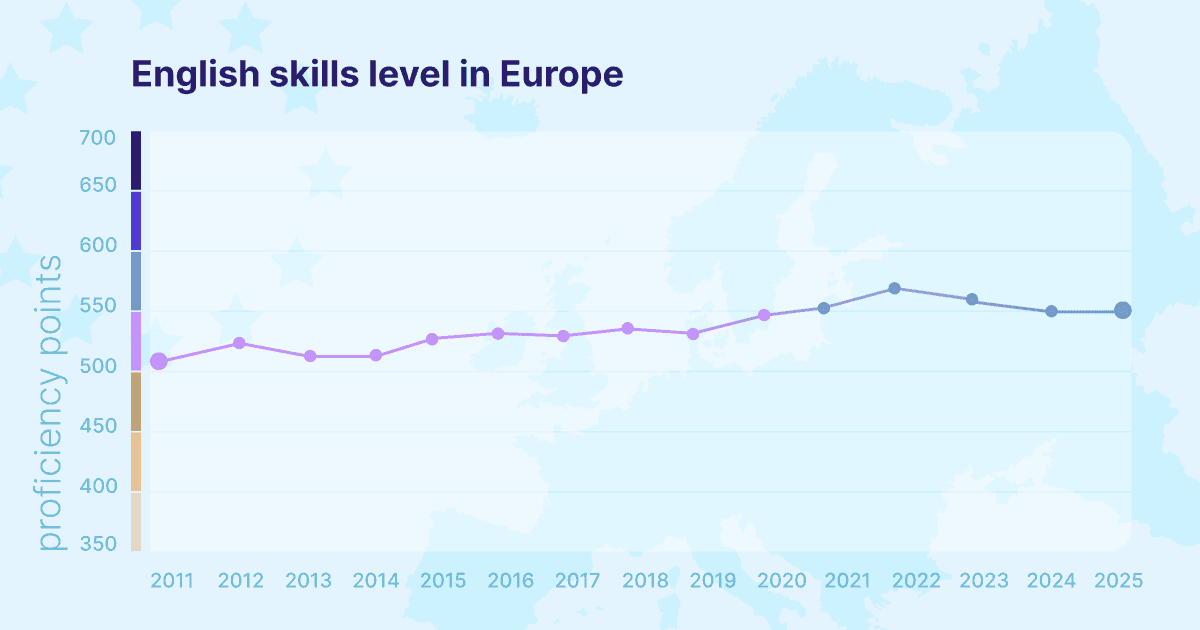
The data was taken from English Proficiency Index.
In 2025, 13 European countries earned their spots in the very high proficiency group.
- The Netherlands
- Croatia
- Austria
- Germany
- Norway
- Portugal
- Denmark
- Sweden
- Belgium
- Slovakia
- Romania
- Finland
- Poland
The Netherlands are also ranked 1st globally. So, if you travel there, feel free to speak English to anyone you meet.
The countries below are less fluent, but are still considered to be of a ‘high proficiency’:
- Latvia
- North Macedonia
- Bulgaria
- Greece
- Bosnia and Herzegovina
- Hungary
- Czechia
- Serbia
- Switzerland
- Estonia
Popular destinations like France, Spain and Italy are of moderate proficiency. It’s okay for tourists, but living there without knowing French/Spanish/Italian will be troublesome.
Keep in mind that the language gap between generations can be huge. For example, in Hungary, older people rarely speak English well and will expect you to know Hungarian.
Tips: Have a Schengen visa? Visit these countries outside the Schengen area.
Which generation is the most fluent
EF also analyses the age group trends from year to year. Unfortunately, the proficency level has been declining since 2020/2021.
| Age group | 2021, points | 2025, points |
|---|---|---|
| 18–20 yrs | 475 | 450 |
| 21–25 yrs | 517 | 497 |
| 26–30 yrs | 529 | 511 |
| 31–40 yrs | 529 | 507 |
| 41+ yrs | 500 | 484 |
If this pattern continues, we may all need to learn an extra language or two, but we’ll see what the future brings.
How it affects expats
Daily life. In most European countries, you can buy groceries, go shopping, and book a hotel room in English. It won’t cause much stress, and people will understand you through body language.
Read more: Italy to issue almost HALF A MILLION work visas for non-EUs.
Banking. You may need to know some basic phrases to open a local bank account. Another way is to bring a friend who can help with translation.
Sending money back home is much easier. Join Profee, an online transfer service, and switch the interface to English or another language you prefer. The service's customer support also speaks several languages, including French, Spanish, Hindi, Afrikaans, Filipino and many others.
Work. It depends on the industry you’re in, but many European employers require you to know the local language. As an English-friendly option, seasonal jobs in agriculture, construction and other fields are a good way to earn. Also, startups are quite open to foreigners, so you may start with them and master the language eventually.
Explore: European salaries. Do you get enough money?
Relationships. A language barrier can be a problem if you want to befriend locals, but it’s not impossible. Plus, don’t forget about other expats out there who often stick together.
FAQ
Where should I live in Europe if I only speak English?
The Netherlands and Scandinavian countries are English-friendly.
What are the top 3 languages to speak?
Chinese, English and Spanish open up the most opportunities.
What is the №1 hardest language?
Mandarin Chinese is often named as the most complex language. Within Europe, Hungarian and Finnish are considered among the most difficult to learn.
Is English still evolving?
Yes, every language is constantly evolving. There is no ‘finish point’ when it comes to the way we speak.