

EU Blue Card 2026: salary threshold, key requirements, application process

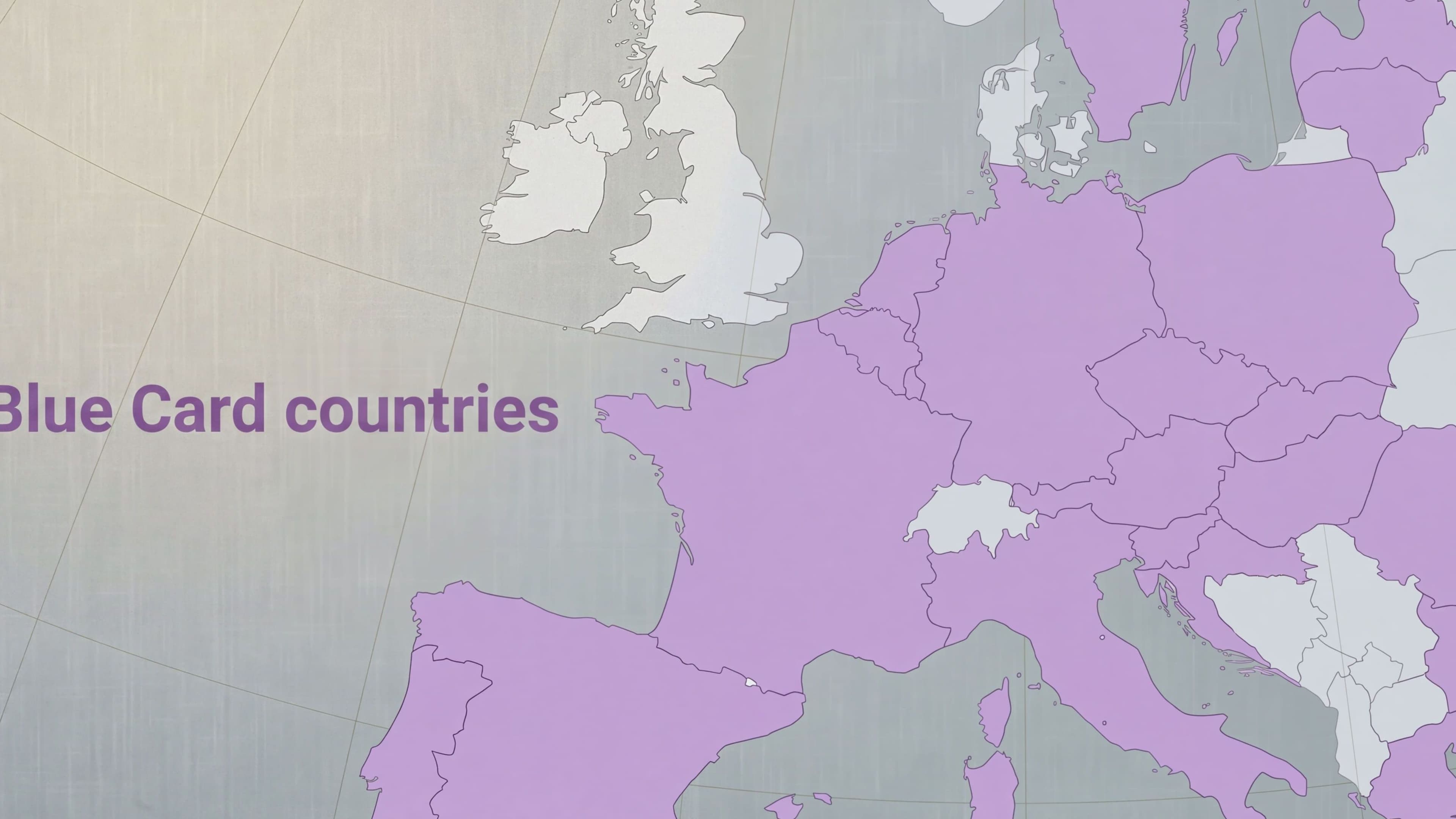
The EU Blue Card is one of the main ways for skilled workers to take up a job and settle in one of the 25 EU countries. Out of 27 members, only Denmark and Ireland don’t take part in the scheme. To qualify, you need a job that meets the Blue Card rules, the right professional qualifications and a salary above the national threshold, which differs in each state.
We’ll use current examples to show how the rules work in practice. By the end of the article, you’ll know what’s needed to get the EU Blue Card in 2026.
EU Blue Card salary thresholds in 2026
Eligibility requirements
Application process
Validity, employment and mobility
FAQ: EU Blue Card rules
EU Blue Card salary thresholds in 2026
EU law sets the standard range at between 1.0 and 1.6 times the average gross annual salary in each Member State (rules may change, so keep an eye on the EUR-Lex updates). Some countries also use lower thresholds for shortage occupations or recent graduates.
The range is fairly wide across Europe:
| Country | Standard threshold in 2026, EUR | Reduced threshold, EUR |
|---|---|---|
| Germany | 50,700/year | 45,934.20/year |
| Netherlands | 5,942/month | 4,754/month |
| Finland | 3,937/month | — |
| France | 53,836.50/year | — |
Salary figures change over time, and each country updates them separately. If you are checking a job offer, use the latest figure published by the national immigration authority.
Planning to work somewhere in the EU? Here are a few guides worth reading.
Eligibility requirements
Three things decide whether you can get a Blue Card: a job offer, the right qualifications, and a salary above the national minimun. Each criteria is checked against the rules of the specific country you are moving to, not EU-wide rules.
A qualifying job offer
You need an employment contract or a binding job offer for at least six months in a highly qualified role. The position should fit your qualifications or professional experience and meet the Blue Card rules in the country where you apply.
The Blue Card is built around paid employment with an employer. If your plan is to freelance, start a company or work for yourself, this is probably not the right route – those cases are covered by different residence permits.
A salary above the national threshold
Your contract salary must reach the Blue Card minimum in the country where you apply. The exact calculation differs by country.
For example, the Netherlands excludes holiday allowance from its Blue Card threshold, while Finland doesn’t count fringe benefits (health insurance, wellness programmes, and so on) or daily allowances. The gap between "total package" and "countable salary" is one of the most common reasons an offer looks qualifying on paper but isn't.
If part of your package comes through benefits or other extras, check which parts count before comparing them with the threshold.
The right qualifications
A higher education degree is the usual route, but professional experience can also qualify in some cases. Germany, for example, lets some IT professionals qualify without a university degree if they have at least three years of relevant IT experience within the previous seven years and meet the other Blue Card conditions. Higher professional qualifications gained outside the EU can count too, provided they are comparable to the local standard.
Some jobs require more than a degree or work experience. In regulated professions, you may also need official permission to practise before you can start the job. A doctor, for example, can meet the Blue Card qualification rules but still needs their medical qualification recognition and a licence to work in that country. Qualification recognition for regulated professions can take several months, so prepare it in advance.
Once you settle down in the EU, you may need to send money to family, yourself or friends back home. Then, you can use the online transfer service Profee. We send money to over 90 destinations – and 95% of our transfers arrive within minutes, as of 2026 (transfer speed and availability may vary by destination and payment method). You can check the exchange rate, transfer fee and the exact amount your recipient gets on the transfer page or in the Profee app.
Application process
EU Blue Card applications are submitted in the country where your job is based and are granted or rejected within 90 days. The process follows these steps:
Get a qualifying job offer. Check that the role, contract length and salary meet the national rules.
Check the current salary threshold. Use the latest figure from the country's immigration authority.
Confirm how your qualifications are assessed. Your degree may need recognition, or professional experience may be accepted instead.
Prepare the documents. The list often includes your passport, employment contract, qualification documents and any licence required for the job.
Submit the application. Depending on the country, you may apply through a consulate, immigration office or online portal.
Get an entry visa if your nationality requires one.
Complete the local steps after arrival. These may include registering your address, giving biometrics and collecting your residence card.
Most complete Blue Card applications should be decided within 90 days (as of 2026, verify on the European Commission website). The processing time can stretch if the authorities need more documents from you, or shorten for recognised employers – some countries offer faster routes that bring the deadline down to 30 days.
“Germany is facing labour shortages across multiple sectors, with some sectors particularly affected, and the Blue Card plays a central role in the labour migration policy in Germany.” – Dr Almina Besic, Assoc. Prof. Dženeta Karabegović, and Prof. Andreas Diedrich, July 2025.

Validity, employment and mobility
A Blue Card lets you change jobs, stay during unemployment, and move to another EU country after 12 months. The exact rules, however, still depend on the country that issued your permit.
| Situation | What the EU rules say |
|---|---|
| How long the card lasts | The standard permit validity period must be at least 24 months (as of 2026, verify on the European Commission website). For a shorter contract, the card should generally cover the contract plus three months, up to the national limit. |
| Changing jobs | You can change employers at any point. In the first 12 months, you notify the authorities and they may check that the new role still qualifies. After a year, the check isn’t so strict. A promotion at the same employer counts as a job change too – if your new role falls outside the Blue Card criteria, the permit can be reviewed. |
| Losing your job | You don’t lose the card immediately. You can usually stay unemployed for up to three months if you have held the card for under two years. The period expands to six months if you have held the card for at least two years. Some countries allow longer. |
| Moving to another EU country | After 12 months of legal residence in the first Member State, you can move to another participating country for highly qualified work. You still have to meet that country's rules and apply for its Blue Card. |
| Bringing your family | Family members can join you under the Blue Card's family reunification rules and may also get access to work. Family reunification applications are submitted separately and processed alongside or after your own Blue Card application. A third-country national family member needs to meet the host country's entry requirements as well. |
Blue Card rules make it more advantageous than a permit tied strictly to one employer. As Micheline van Riemsdijk, Professor of Human Geography at Uppsala University, puts it: "The Blue Card is more flexible for both employers and migrants." However, moving countries, changing jobs or bringing family members can still involve national paperwork, so check the local procedure before making the change.
FAQ: EU Blue Card rules
How can you get an EU Blue Card?
You need a qualifying job offer, the right qualifications or professional experience, and a salary that meets the Blue Card threshold in the country where you apply.
How much is an EU Blue Card?
There is no single EU-wide fee. In 2026, a first EU Blue Card application can cost roughly 100–630 EUR, depending on the country and how you apply. For example, it costs up to 100 EUR in Germany, 423 EUR in the Netherlands, and 530 EUR online or 630 EUR on paper in Finland. Fees can change, so check the latest amount before submitting your application.
Can I convert my EU Blue Card to permanent residence?
Yes, in many countries, the Blue Card can lead to permanent residence after you meet the required residence period and other local conditions.
How long does it take to get an EU Blue Card?
A complete application should be decided within 90 days under EU rules. The final processing time depends on the country, the employer's status and whether any documents are missing.
Which countries can I visit with an EU Blue Card?
You can travel within the Schengen Area for up to 90 days in any 180-day period for short stays.
What happens to my Blue Card if my employer goes out of business?
It follows the same rules as losing any job. You have three months to find a new qualifying role if you have held the card for under two years, and six months if you have held it longer. The card is not cancelled the moment your employer closes.