Beyond Kindergeld: What benefits you can claim as a family in Germany

Germany has a comprehensive family benefits system – and most families only scratch the surface of what they can claim. Beyond the well-known Kindergeld payment, there are housing allowances, parental payouts, tax deductions, and protected leaves that together can add up to thousands of euros a year. This guide covers all of it, so you know what benefits you can get.
Financial payouts: What you can claim every month
Tax benefits for families in Germany
Parental leave, maternity protection & sick days
Financial payouts: What you can claim every month
Germany has built a layered system of monthly payments for families, including Kindergeld, Kinderzuschlag, Elterngeld, Geschwisterbonus, Wohngeld, and Unterhaltsvorschuss. Some are universal – you get them no matter what you earn. Others are targeted at lower-income households or newly arrived parents. The key thing to understand upfront: most of these family benefits in Germany don't arrive automatically. You have to apply. The main office handling applications is the Familienkasse (Family Benefits Office), which operates under the Bundesagentur für Arbeit (Federal Employment Agency). If you're on Bürgergeld or other social support, some applications go through the Jobcenter instead.
Kindergeld: The universal child benefit
Kindergeld is the basic monthly payment every family gets. It doesn’t matter if you’re a CEO or a student; the amount is the same for everyone. Child benefit in Germany is paid for all children up to age 18, for unemployed children up to 21, and for children in training or studies up to age 25. As of 2026, the German child benefit amount is 259 EUR per month per child, with no income cap whatsoever. You can only claim it retroactively for the last six months, so apply as soon as possible after birth or arrival in Germany – delays cost you real money. Submit form KG1 to your local Familienkasse, or apply online via the Bundesagentur für Arbeit website.
Explore more: German Kindergeld guide, application & eligibility.
Kinderzuschlag: Extra benefit for low-income families
Kinderzuschlag is designed for working families who earn enough for themselves but not quite enough to cover their children's needs on top. Without the support, these families risk being pushed into Bürgergeld even though they're in work. In 2026, the maximum Kinderzuschlag is 297 EUR per child each month. To qualify, couples need to earn at least 900 EUR a month, and single parents at least 600 EUR. The amount you get drops as your salary goes up, and since they check your income every six months, you have to keep reapplying. If you qualify, you also get the "Bildungs- und Teilhabepaket" – which basically means the state pays for things like school lunches and trips.
Elterngeld: Parental allowance after birth
Elterngeld is the safety net that lets you spend time with your newborn without worrying about how to pay rent, following the Bundeselterngeld- und Elternzeitgesetz (BEEG). The standard Elterngeld monthly allowance is 65% of your average net income from the 12 months before the birth, with a minimum of 300 EUR/month and a maximum of 1,800 EUR/month. Even if you weren’t working before, you still get that 300 EUR minimum. You have three choices:
- Basiselterngeld: You get the full monthly amount for up to 12 months (or 14 if both parents split the leave).
- ElterngeldPlus: You get half the money but for twice as long. This is the smart move if you want to start working part-time earlier.
- Partnerschaftsbonus: You get four extra months of ElterngeldPlus if both parents work between 24 and 32 hours a week at the same time.
From April 2025, both parents can only take the basic allowance at the same time for one month during the first year (unless you have twins or a premature birth). Also, if your household earns more than 175,000 EUR a year, you don’t get any Elterngeld at all. Keep in mind that while the Elterngeld money isn't taxed directly, it can push you into a higher tax bracket at the end of the year.
Geschwisterbonus: Sibling bonus
If you have another baby while your older children are still small, the state adds a Geschwisterbonus to your Elterngeld. The bonus adds either 10% of your allowance or 75 EUR a month – whichever is higher. You get this if you have one child under 3 or two children under 6. The bonus stops the moment a child hits the age limit, so check your dates carefully before applying to the Elterngeldstelle. You don't need a separate form for this; it’s automatically included in your main Elterngeld application.
Wohngeld: Housing allowance
Wohngeld is a monthly housing allowance for lower-income families who don't qualify for Bürgergeld but still struggle to cover rent. The amount is calculated individually based on your household size, income, and local rent costs.
Hidden benefit: if you get Wohngeld or Kinderzuschlag, you usually don't have to pay for Kita (daycare) fees.
A major update in 2023 made it much easier to qualify, so check with your local Wohngeldbehörde even if you were rejected in the past.
Unterhaltsvorschuss: Maintenance advance for single parents
If the other parent isn’t paying child support, the state steps in with Unterhaltsvorschuss. In 2026, the benefit pays 227 EUR for kids up to age 5, 299 EUR for kids aged 6–11, and 394 EUR for those up to 17. The Jugendamt (Youth Welfare Office) pays you directly and then attempts to recover the funds from the non-paying parent. You can get the payments until your child turns 18, and it doesn't stop you from getting Kindergeld or Kinderzuschlag. Apply at the Jugendamt the moment payments from the other parent stop or become unreliable.

Tax benefits for families in Germany
Germany's tax system has several built-in reliefs for parents: Kinderfreibetrag, Entlastungsbetrag für Alleinerziehende and childcare cost deduction. The state does a "favourability test" behind the scenes to see if a tax deduction or the monthly cash payment is better for you. You can’t keep both, but the tax office will always give you a bigger saving. Most of this only happens if you file your Steuererklärung (tax return) at the end of the year.
If you're employed, most reliefs apply once you register the birth and your child receives a Steuer-ID. But you still need to file a Steuererklärung to receive what you're owed. This is especially relevant for families where one partner holds tax class V, as they often leave significant reliefs unclaimed without realising it.
Kinderfreibetrag: Child tax allowance
The Kinderfreibetrag is a chunk of your income that the state doesn't tax. In 2026, it’s 6,828 EUR per child. The tax office automatically checks if the deduction saves you more money than the Kindergeld you receive. If the tax break is better, they apply it; if not, you just keep the Kindergeld.
If you are in tax class V or VI, you aren't eligible for the Kinderfreibetrag allowance.
Entlastungsbetrag für Alleinerziehende: Single parent tax relief
Single parents get an additional layer of tax benefits for families in Germany through the Entlastungsbetrag für Alleinerziehende. In 2026, single parents can exclude an additional 4,260 EUR/year from their taxable income, plus 240 EUR for each further child. Combined with the full Kinderfreibetrag, a single parent raising one child can have up to 9,060 EUR excluded from their taxable income on top of the standard personal allowance.
Childcare cost deductions
If you pay for a Kita or a Tagesmutter, you can write off a huge part of that cost on your taxes. From January 2025, 80% of daycare or childminder costs are deductible, up to a maximum of 4,800 EUR/year per child. The deduction applies to children under 14 and covers registered Kita fees, approved Tagesmutter costs, and similar formal childcare arrangements. Keep invoices and proof of bank transfer – cash payments are not accepted by the Finanzamt. Include the amounts in the Anlage Kind section of your annual Steuererklärung; for many families in cities with high Kita fees, this alone saves several hundred euros per year.
A tax class tip worth knowing
In Germany, your tax class decides how much cash you take home each month. Since Elterngeld (parental allowance) is calculated based on your average net income from the year before the birth, a simple tax switch can boost your monthly payout.
If you are married, the parent planning to take the most leave should switch to Tax Class III as early as possible – ideally at least seven months before the birth (or before maternity leave starts). This class has the lowest deductions, making your "official" net income higher.
For example:
- The default: A parent in Class IV earns 2,500 EUR net. Their Elterngeld (approx. 65%) would be 1,625 EUR.
- The switch: By moving to Class III, their take-home pay might rise to 2,800 EUR. Their Elterngeld then jumps to 1,820 EUR.
That is an extra 195 EUR every month for the entire benefit period, just for filing one form. You can request this switch online via ELSTER, and it typically takes effect the following month.

Parental leave, maternity protection & sick days
Beyond the monthly payments and tax reliefs, Germany provides some of the strongest legal protections in Europe for working parents: Mutterschutz, Elternzeit and Kinderkrankengeld. The rules run from the moment of pregnancy through your child's early years, covering dismissal protection, structured leave entitlements, and paid sick days when your child falls ill.
The key thing to remember: Elterngeld (the money) and Elternzeit (the time off) are two different things with different rules. You can take the time off without the money, or vice versa, though most people do both.
Mutterschutz: Maternity protection
Mutterschutz is the legal framework that protects expectant and new mothers in the workplace, and it applies automatically from the moment you notify your employer of your pregnancy. It prohibits work in the last 6 weeks before birth (unless the mother explicitly opts in) and in the first 8 weeks after birth, extended to 12 weeks following premature or multiple births. During this time, you can't be fired.
The financial side: Mutterschaftsgeld (maternity benefit in Germany) is paid by your statutory health insurance fund at up to 13 EUR/day, and your employer has to pay the rest, so you still get your salary.
Elternzeit: Parental leave
Elternzeit is parents’ right to stop working or go part-time to raise a child. You're entitled to up to 3 years of Elternzeit per child. You can even save up to 24 months of that leave to use later, between your child’s 3rd and 8th birthday. You are safe from being fired while on leave, and you can still work up to 32 hours a week if you want to. Just make sure to give your employer written notice: 7 weeks in advance for the first three years, and 13 weeks if you're using it later on.
Kinderkrankengeld: Sick leave when your child is ill
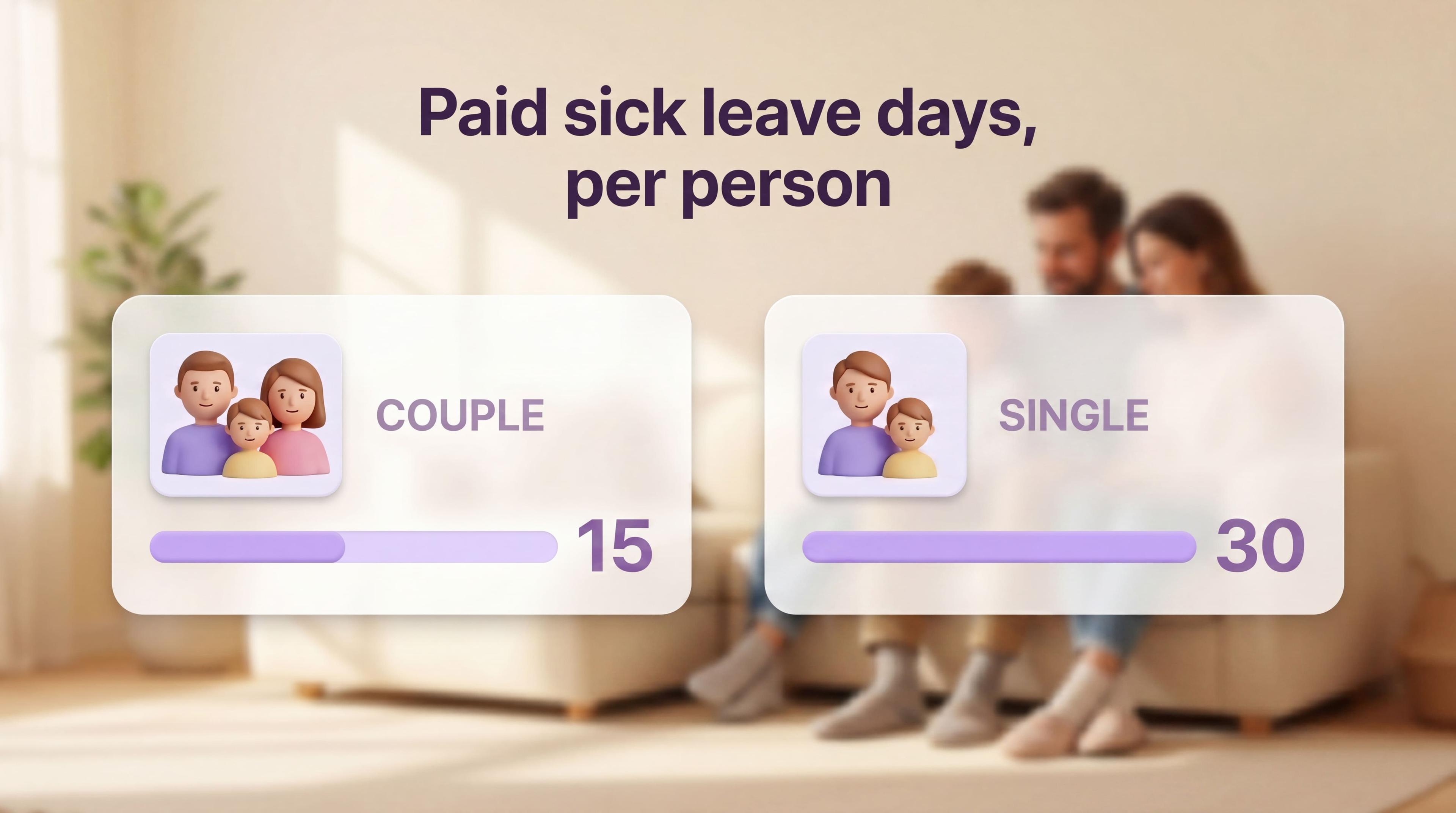
Kinderkrankengeld is the paid sick leave benefit that covers you when your child falls ill and you need to stay home. You don't burn through your own sick days, and you don't lose income. In 2026, each parent with statutory health insurance can take up to 15 working days per year per child under age 12. Single parents receive 30 days. For families with multiple children, the cap rises to 35 days per parent, and 70 days for single parents with multiple children. In cases of serious illness requiring palliative care, there is no day limit at all. To claim, get written confirmation from your child's paediatrician and submit it to your Krankenkasse. The health insurance fund pays you directly. Kinderkrankengeld days have no effect on your Elterngeld calculation.
How to apply for Kindergeld in Germany?
You apply through the Familienkasse (Family Benefits Office).
- Online: Use the "Kindergeld Online" portal on the Bundesagentur für Arbeit website.
- By Post: Fill out forms KG1 and Anlage Kind, then mail them to your local office.
Can foreigners claim Kindergeld in Germany?
Yes, if you live in Germany and have a legal right to stay. Non-EU citizens can get Kindergeld if they have a settlement permit or a residence permit that allows them to work.
Note: If you are here on a student visa, you usually cannot claim the benefit.
What is the difference between Kindergeld and Kinderzuschlag?
- Kindergeld: Basic money for every child, no matter how much you earn (259 EUR in 2026).
- Kinderzuschlag: Extra money for low-earning parents who work but don't make quite enough to cover the kids (up to 297 EUR). You must already be receiving Kindergeld to apply for this extra "top-up."
Who will pay my maternity leave?
Your money during Mutterschutz (the weeks before and after birth) comes from two places:
- Health insurance: They pay Mutterschaftsgeld (up to 13 EUR per day).
- Your employer: They pay the "top-up" to make sure you get your full regular salary.
If you are self-employed or have private insurance, the rules are a bit different, but you usually apply through the Federal Social Security Office (BAS).
Do stay-at-home moms get paid in Germany?
Yes, via Elterngeld (Parental Allowance).
- Even if you didn't work before the baby was born, you get a minimum of 300 EUR per month for the first year.
- If you did work, the state pays you about 65% of your old salary to stay home.