
How to find a job in Poland as a foreigner in 2026

Finding a job in Poland starts with three steps: confirming that you are allowed to work, preparing a clear CV, and searching through local job portals or registered employment agencies. To come out as a winner in the competitive job market, you need a targeted job search strategy – in this article, we cover practical tips for the start of your career in Poland.
Are you allowed to work in Poland?
Where to search for jobs in Poland?
How to prepare a CV for Poland?
Do you need a cover letter?
How to behave during the job interview?
Can diaspora help you?
What are the employment contracts in Poland?
FAQ – Finding a job in Poland
Are you allowed to work in Poland?
Most people from outside the EU, EEA, and Switzerland need two things: a valid legal basis for staying (visa/permit) and proper work authorisation to be legally employed, as of 2026. Depending on your circumstances, you may need to secure a specific work permit, a registered declaration, a seasonal work permit, or a combined residence and work permit.
From April 27th, 2026, foreigners in Poland must submit applications for temporary residence, permanent residence, and long-term EU resident status electronically through Poland’s MOS system.
Tips: The pros and cons of living in Poland.
Do all residence cards allow unrestricted work?
No, a temporary residence and work permit usually allows you to work only under the conditions stated in the permit. These may include a particular employer, position, salary, working time, and contract type.
When one of those conditions changes, your work authorisation needs to be updated, and you may need to apply again to change the permit. The current rules are explained on the official temporary residence and work permit page.
So, don’t write “unrestricted right to work” on your CV unless your current immigration status gives you open access to the job market.
Who can be employed through a simplified procedure?
Citizens of Moldova, Armenia, Belarus, Georgia, and Ukraine may be employed through Poland’s simplified declaration procedure. The employer registers a declaration of entrusting work to a foreigner, and they may work during the period covered by that declaration, but no longer than 24 months. In that case, you won’t need a traditional work permit – but you must hold a residence permit anyway.
You may find official rules on the Polish Ministry of the Interior and Administration website.
Where to search for jobs in Poland?
Polish employers advertise on general portals (Pracuj.pl, Jober.pl), specialist job boards (No Fluff Jobs, RocketJobs.pl), LinkedIn, public employment services, and recruitment agencies.
General Polish job portals
Pracuj.pl, Praca.pl, and OLX Praca are among the biggest general portals:
| Portal | Description | English-speaking vacancies |
|---|---|---|
| Pracuj.pl | It carries vacancies in finance, administration, sales, engineering, logistics, retail, technology and management. | Yes |
| Praca.pl | A broad Polish job portal with vacancies from multiple sectors and cities, as well as career and CV resources. | Hard to find |
| OLX Praca | Commonly used for warehouse, production, construction, hospitality, retail, transport, cleaning, service and entry-level work. | Yes, type ‘English-speaking jobs’ |
| Aplikuj.pl | A national job portal with vacancies from different regions and industries, together with salary and CV tools. | Hard to find |
| infoPraca.pl | A general recruitment platform with filters for profession, sector and location. | Hard to find |
| GoWork.pl | Combines job advertisements with employee reviews. Reviews can provide useful signals, but anonymous comments should not be treated as proven facts. | Hard to find |
| Jober.pl | A Polish portal carrying vacancies in multiple professional and manual-work categories. | Yes, use filter ‘No knowledge of the language’ |
| Jobdesk.pl | A job-search website with vacancies from employers and recruitment companies. | Hard to find |
Technology and specialist job portals
Go to No Fluff Job for tech jobs and PocketJobs for marketing listings:
| Portal | Description |
|---|---|
| No Fluff Jobs | A specialist platform known primarily for technology vacancies. It also covers data, finance, marketing and sales. |
| Just Join IT | A major Polish technology recruitment platform for software development, testing, data, DevOps, cybersecurity, project management and related areas. |
| RocketJobs.pl | Focuses on marketing, sales, HR, finance, customer service, design, media and business operations. |
| Skillshot.pl | A specialist portal for the Polish video-game industry, including programming, game design, animation, art, production and quality-assurance roles. |
Jobs that use English or another foreign language
Search English jobs on Careers in Poland, EnglishJobs and LinkedIn:
| Portal | Description |
|---|---|
| Careers in Poland | Designed for international and multilingual candidates. It carries vacancies at multinational companies and allows users to search by language, location and professional field. |
| EnglishJobs.pl | Aggregates Polish vacancies advertised for English speakers. Some positions may still require basic or intermediate Polish. |
| LinkedIn Jobs | Useful for corporate, professional, technology, finance, sales, marketing and international roles. |
Official employment portals
You can trust EURES and Central Job Offer database:
| Portal | Description |
|---|---|
| EURES | EURES is the EU employment network. It provides job listings, information about working and living conditions, and employment support across the European Economic Area. |
| Central Job Offer Database | This is the official Polish database of vacancies submitted to public employment offices. |
| Public Employment Services | The Polish Public Employment Services portal provides information about labour offices, jobseeker services, employment law and assistance programmes. |
| ePraca | The official employment-services platform provides access to job-office services and online procedures. |
| Zielona Linia | Zielona Linia is an official Polish employment information and consultation service. It publishes guidance on contracts, taxes, social insurance, benefits and employing foreigners. |
How to use a recruitment agency safely?
A legal employment agency operating in Poland must be entered in the National Register of Employment Agencies, commonly called KRAZ. Check the agency through the official KRAZ register before sending documents, paying any costs, or travelling for work.
Agencies don’t charge job seekers a recruitment fee. They may charge you only for document translation, verification of a foreign qualification, and other related services.
KRAZ registration proves that the business is registered as an agency. It doesn’t guarantee that every advertisement, recruiter account, or social-media message using its name is genuine. So, always stay alert.
Check these details before accepting an agency job:
- the agency’s full registered name;
- its KRAZ number;
- its Polish company-registration details;
- the name and address of the workplace;
- the name of the actual employer or user employer;
- the contract type;
- the gross hourly or monthly salary;
- the expected schedule;
- overtime rules;
- the cost of accommodation and transport;
- all other deductions;
- the salary-payment date;
- the work permit or declaration details;
- other details you find important.
A contract with a foreign worker must be signed in writing and presented in a language the worker understands – never move to Poland without a written contract.
Warning signs
Be careful when a recruiter:
- refuses to provide the employer’s legal name;
- communicates only through WhatsApp or Telegram;
- asks for payment to a private bank account;
- offers a guaranteed visa or a fake employment visa;
- asks you to start working without a written contract;
- promises a net salary but will not state the gross rate;
- refuses to explain accommodation or transport deductions;
- wants to keep your original passport;
- pressures you to pay immediately.
Something looks suspicious? You can report violations to Poland’s National Labour Inspectorate.

How to prepare a CV for Poland?
A clear one-or two-page CV with a simple reverse-chronological structure (your latest job first) will pass for most commercial roles. If you hold a foreign qualification, make sure to list it clearly alongside its Polish or international equivalent. You should include:
- photograph (optional);
- full name;
- telephone number with international country code if you don’t have a Polish one;
- professional email address;
- current city and country;
- LinkedIn profile, when relevant;
- short professional summary;
- employment history;
- education and any relevant foreign qualification certifications;
- professional and technical skills;
- languages and your verified language proficiency levels;
- certificates and licences relevant to the vacancy.
You don’t need to provide a street address, marital status, religion, parents’ names, or other personal details unrelated to the job.
GDPR or RODO clause
A GDPR (General Data Protection Regulation) or RODO clause is your agreement to your data being processed. If the employer requests, include these in your CV:
In English:
I consent to the processing of the personal data provided in my application for the purpose of conducting the recruitment process for the position for which I am applying.
In Polish:
Wyrażam zgodę na przetwarzanie danych osobowych podanych w mojej aplikacji w celu przeprowadzenia procesu rekrutacji na stanowisko, na które aplikuję.
Where the vacancy provides its own wording, use it without editing.
Do you need a cover letter?
A cover letter isn’t a requirement, but attaching one will increase your chances. Explain to your potential employer:
- why you want the specific job;
- why your experience matches it;
- a career change;
- a gap in employment;
- relocation to Poland;
- a less obvious connection between your background and the role (like university projects or volunteering).
Keep it to one page and focus on what you can do for the employer. Don’t simply repeat the CV.
How to behave during the job interview?
Most importantly, be punctual – arrive or join the call a few minutes early. Check the address, meeting link, and contact details before the interview. Then, try to present yourself as a reliable and polite expert:
Start with a professional tone. In Polish, Pan and Pani are standard formal forms of address. International teams may use first names immediately – you can do the same in such cases.
Give examples, not only responsibilities. Instead of saying: Responsible for customer support. Say: Answered customer enquiries in English and Polish and resolved payment and account issues.
State your Polish level honestly. If you’re asked about your language proficiency, don’t lie. If your current level is low, admit it and mention that you’re actively learning the language.
Can diaspora help you?
Diaspora networks can help you understand the local job market, find referrals, visit professional events, and share the real experience with some employers or agencies. However, a Facebook or LinkedIn post isn’t proof that a job is legal. Verify the employer, agency, contract, and work-authorisation documents yourself.
Here are some foreign communities in Poland:
- Indian Community of Poland
- Fundacja Ukrainka w Polsce
- InterNations Warsaw
- Polshadagi Uzbeklar – Official Uzbeks in Poland
- Work in Poland for All Nigerians
- Moldoveni în Polonia
- Work and Help for Foreigners in Poland
- Foreigners in Poland
- Expats in Poland
- Asians and Africans in Poland – Jobs, Support and Information
Diaspora communities might also help you with rent, cultural integration, legal processes and recommend services to make your life easier. One of such is Profee – our online service for sending money from Poland to 90+ destinations. Fully legal, protected and fast, with 95% transfers arriving within minutes, Profee brings some peace to your relocation.
What are the employment contracts in Poland?
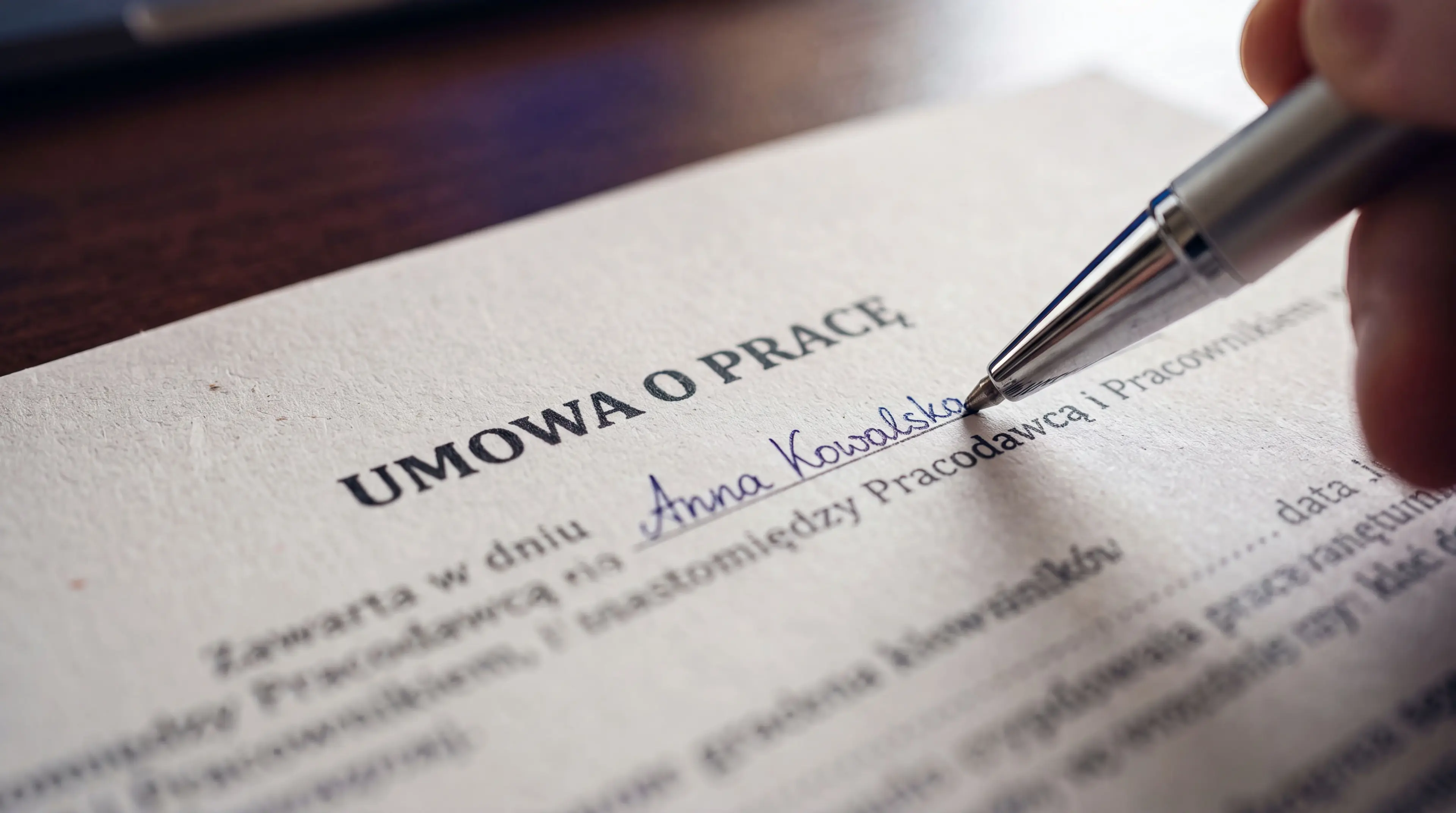
You may be offered a basic employment contract (umowa o pracę) or a civil-law contract (umowa zlecenie).
Umowa o pracę – employment contract
An umowa o pracę is governed by the Polish Labour Code, creates an employment relationship, and provides statutory employee rights. An employment contract must be in writing and must state the parties, contract type, and employment conditions. The official requirements are listed on the government’s contract of employment page.
Depending on the contract and circumstances, Labour Code protections include:
- minimum-wage rules;
- paid annual leave;
- regulated working time;
- overtime rules;
- sick-leave rights;
- parental rights;
- notice periods;
- social and health insurance.
Standard Labour Code working time is generally eight hours a day and an average of 40 hours a week in an average five-day working week, although different working-time systems may apply.
Umowa zlecenie – contract of mandate
An umowa zlecenie is a civil-law contract rather than an employment contract, so Labour Code protections don’t automatically apply in the same way. You won’t normally get an automatic right to paid annual leave, so check your contract regarding holiday arrangements, breaks, and cancellation rules.
A statutory minimum hourly rate of 31,40 PLN (as of 2026) applies to many mandates and service contracts. Depending on the worker’s status, an umowa zlecenie may include:
- social-insurance contributions;
- health-insurance contributions;
- income tax;
- voluntary sickness insurance.
Tips: How to calculate your gross & net salary in Poland.
FAQ – Finding a job in Poland
Should you attach a photo to a Polish CV?
A photo is optional. Local companies may expect one, but international employers may prefer CVs without photographs to avoid biases. When you choose to add one, use a clear professional head-and-shoulders image. Do not include a passport scan, holiday photograph, or heavily filtered selfie.
Is it easy to find jobs in Poland?
It’s possible to find a job, but recently, businesses have been hiring fewer and fewer people.
‘In 2026, 51% of companies plan to maintain their current employment level. Recruitment is planned by 18% of enterprises, which is 2 percentage points more than the previous year.’ – Krzysztof Inglot, labour market expert.
What jobs can a foreigner get in Poland?
All the same as locals – in IT, healthcare, marketing, hospitality, construction, and beyond. However, foreigners often can’t secure a position that matches their qualifications.
‘With the labour market suffering staff shortages, finding work is not a big challenge, but the question is to what extent refugees will be able to use their expertise and professional experience rather than wasting their potential in low-skilled jobs.’ – Krzysztof Inglot, labour market expert.
Is Poland still hiring foreign workers?
Yes, Polish companies are actively hiring foreign workers to fill open roles.
What are the most needed jobs in Poland?
IT, healthcare, construction, and manufacturing are some of the fields facing a notable labour shortage.