Canadian culture and traditions: Tips for expats

To feel more like a local, you must deep dive into Canadian culture. That’s what this article was written for! Scroll down to read about Canadian cultural traditions and values every expat should know.
Canadian society
Canadian cultural symbols
Canadian celebrations
Canadian cultural traditions
FAQ – What are some Canadian traditions?
Canadian society
National identity and relationships between citizens are an important part of modern Canadian culture.
Indigenous peoples
There are three groups of indigenous peoples in Canada: the First Nations, the Inuit, and the Métis. Authorities try to keep them acknowledged and respected on the national level, and citizens act in line with this agenda. As an expat, you know like no one else how crucial it is to feel accepted and recognised, so keep this energy towards indigenous peoples. We're all humans anyway.
You can read more about Indigenous art and history on the website of Canadian government.
Languages
We can’t talk about Canadian culture without touching upon languages. French and English are the country's two official languages, with 98.1% of the population speaking at least one of them. Bilingualism is the norm; more than 200 languages, except French and English, are spoken in the country, and Indigenous ones are protected and revitalised.
Multiculturalism
You can already sense that modern Canadian culture is very open to people outside of it. The country has developed a system of integration with no pressure on newcomers. So, as an expat, you must behave accordingly. Don't cause fights, respect others, and work together to make Canada a better place to live.
To make your family's life better, too, consider sending them financial support. You can transfer money from Canada to over 90 destinations with Profee. It's the trusted online service used by over 800,000 expats. The best part – rates are always hot, and delivery is fast.
Canadian cultural symbols
There are ten official Canadian cultural symbols. We listed all of them and added some interesting facts which you can bring into a conversation.
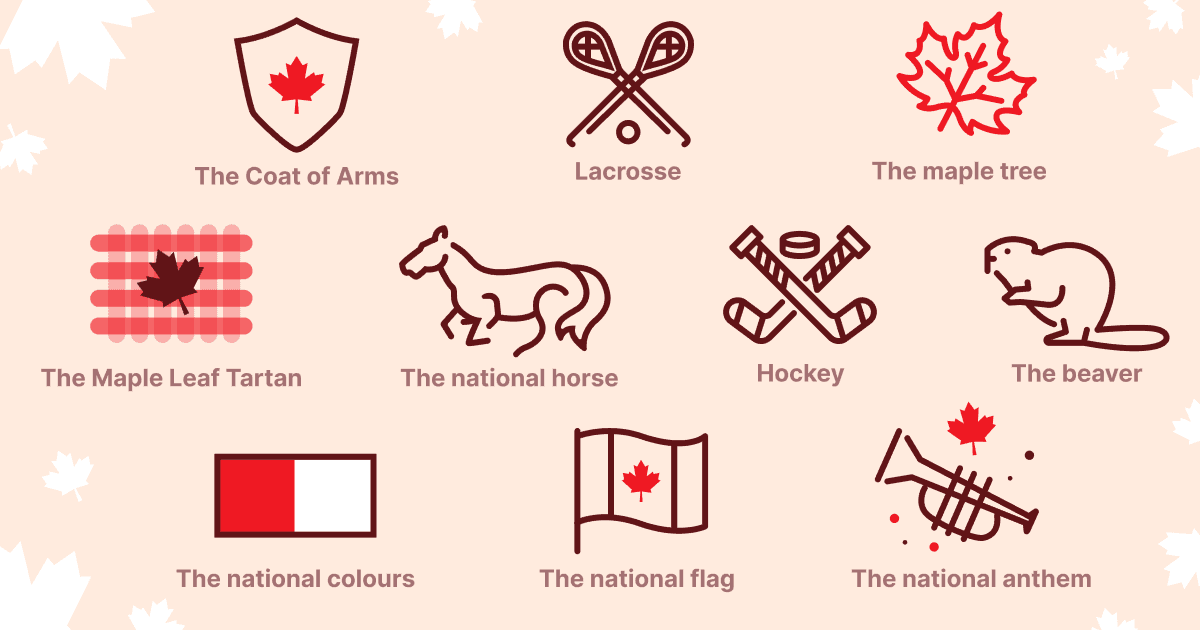
The Coat of Arms
- A visual representation of the country, together with the national flag.
- Adopted in 1921.
- Includes the royal emblems of England, Scotland, Ireland, and France, as well as Canadian cultural symbols.
- Contains Canada's motto, ‘A Mari Usque Ad Mare’, translated as ‘From Sea to Sea’.
The national flag
- Adopted in 1965.
- National Flag of Canada Day is honoured each year on February 15th. This day is one of the Canadian traditions and celebrations, yet not a public holiday.
- The white colour represents winter snow, the red symbolises autumn maple leaves.
The beaver
- This mammal was acknowledged as a national symbol in 1975.
- Featured on the first Canadian postage stamp.
- The species almost disappeared in the 19th century due to the fur trade. Currently, the population has recovered.
The national anthem
- Proclaimed in 1980, but first performed in 1880, a century earlier.
- Composed by Calixa Lavallée.
- The original lyrics were written in French and later adapted into English.
Lacrosse
- Official national summer sport.
- It has its roots in ancient games played by the First Nations of North America.
- The last time Lacrosse was a part of the Olympics was in 1908. It’ll make a return in 2028.
Hockey
- Official national winter sport.
- The origins of the game are a matter of debate, but Canada played a significant role in shaping the set of rules.
- One of the greatest moments in Canadian sports history is the Canada-U.S.S.R. Summit Series in 1972.
The maple tree
- Canadian maple products are exported to approximately 60 countries worldwide.
- Maple season festivals are celebrated across the country – one of the sweetest Canadian traditions.
- Indigenous peoples utilised maple as a source of medicine and raw materials for tools.
The national horse
- Originally a mixed species (Arabian, Barb and Andalusian horses), it has adapted to the Canadian climate and landscape and become a unique breed.
- A strong, small and intelligent breed,
- Canadian horses are now at risk of extinction.
The Maple Leaf Tartan
- April 6th is the official Tartan Day in Canada.
- Designed in 1964 for the 100th anniversary of Confederation (1967).
- Is a symbol of inclusion as it was meant to be worn by everyone in the country.
The national colours
- White and red, the colours of the flag.
- They are often used in Canadian traditions.
- It has roots in the colours of England (the St. George's Cross) and France (the royal emblem).
These are the symbols cherished in Canadian culture. They represent the vibe of the country pretty well: animals, flora, sports and endless love towards the place they call home.
Tips for expats in Canada:

Canadian traditions and celebrations
Everybody loves good celebrations, gatherings and days off. Canadian culture is no exception! Officially, there are thirteen public holidays in Canada:
New Year
Always celebrated on January 1st. It's time to reflect on the past and welcome the new year with hope and gratitude.
Good Friday
The date changes each year. Good Friday is a Christian celebration marking the death of Christ. It’s one of the most important religious days in the country.
Easter Monday
This holiday follows Good Friday, so the date changes yearly, too. Canadian traditions on Easter include egg painting, petting animals and family get-togethers. It’s a happy and lovely occasion for everyone involved.
Victoria Day
Celebration of the Birthday of Queen Victoria. The day is marked with parades, fireworks, and barbecues.
Saint-Jean-Baptiste Day (Quebec only)
Quebec's national holiday is observed on June 24th and honours the summer solstice, as well as the unity of the French Canadian community.
Canada Day
On July 1st, the country commemorates the anniversary of Canadian Confederation. On this day, concerts, festivals and events are held to praise Canadian culture and traditions.
Civic Holiday
Falls on the first Monday of August and was added as an extra day off during the summer. Depending on the location, the holiday is known by various names, such as Heritage Day (Alberta), British Columbia Day, or Simcoe Day (Toronto).
Labour Day
The roots of this holiday date back to 1872, when the country was shaken by workers' strikes and the Nine-Hour Movement. Now it's a public holiday, allowing employers to rest and enjoy their well-deserved time off work.
National Day for Truth and Reconciliation
Even though it’s a holiday, this day is not for entertainment. The country reflects on the harm caused by the residential school system, which ruined the lives of thousands of children. To honour the victims, people wear orange clothes and accessories.
Thanksgiving Day
Falls on the second Monday of October. Thanksgiving Day is one of the family-oriented Canadian traditions. Relatives gather together, eat roast turkey and share a cosy dinner.
Remembrance Day
Celebrated on November 11th, this day marks the end of the First World War. People show respect by wearing a poppy, participating in the 2 minutes of silence and making donations.
Christmas Day
Christmas doesn’t need an introduction. Streets and houses are decorated with lights, people give gifts to each other, and everyone is excited about the end of the year.
Boxing Day
The day after Christmas, when families can meet over dinner again. Those who can’t eat anymore, play hockey or go shopping to catch sales. Canadian culture and traditions that we truly deserve :)
Canadian traditions and celebrations vary from holiday to holiday, so you won’t get bored as a foreigner.
Canadian cultural traditions
To wrap things up, we’ve collected several Canadian culture examples from Reddit that will help you immerse yourself in the country even more. So, what are some Canadian traditions?
- During the Calgary Stampede, people can enjoy a free pancake breakfast.
- Canadians adore canoe camping. It’s the perfect way to put problems aside and live in the moment.
- In March, maple syrup farms treat visitors with the Cabanes à sucre, or sugar shacks – a tasty Canadian tradition.
- Wedding socials. These are pre-wedding fundraiser parties where guests pay for drinks and food to help the couple with wedding expenses.
- Garage sales are very popular. It’s in Canadian culture to be cautious about the environment. So, selling staff that you don’t need is a common practice.
Canadian cultural traditions are very diverse, and that’s what makes them beautiful.
FAQ – What are some Canadian traditions?
What things represent Canadian culture?
Canadian culture and traditions are represented by:
- The Coat of Arms
- The national flag
- The beaver
- The national anthem
- Lacrosse
- Hockey
- The maple tree
- The national horse
- The Maple Leaf Tartan
- The national colours
What is the most popular celebration in Canada?
Canada Day is one of the most significant holidays celebrated throughout the country.
What do Canadians call Santa?
Santa Claus or Père Noël among the French-speaking population.
What is the Canadian way of life?
Canadians are polite, balance work and life, and love outings. They don’t chase the first place but rather become better and find value in who they are.
How to send money from or to Canada?
Follow these six steps to transfer money from or to Canada in a couple of minutes:
- Join Profee.
- Select countries.
- Add the transfer amount.
- Choose the payment method.
- Enter the recipient details.
- Confirm.