Finding a job in Germany – job portals, CV tips, qualification recognition

Germany has 45.61 million people in work and a low vacancy rate of 2.80% in 2026 – a stable market, but it means the competition is tough. To get hired, you must perfectly understand the local market. Though companies use AI hiring and hybrid setups now, traditional rules like being perfectly on time, preparing thoroughly, and showing verified skills still come first. To secure a job in Germany, explore portals, CV and cover letter tips, and qualification recognition requirements in this guide.
Finding your way around job portals in 2026
The German-style CV (Lebenslauf)
The cover letter (Anschreiben)
Compiling and submitting your application
Mastering the interview (Vorstellungsgespräch)
Getting your qualifications recognised (Anerkennung)
Part 1: Finding your way around job portals in 2026
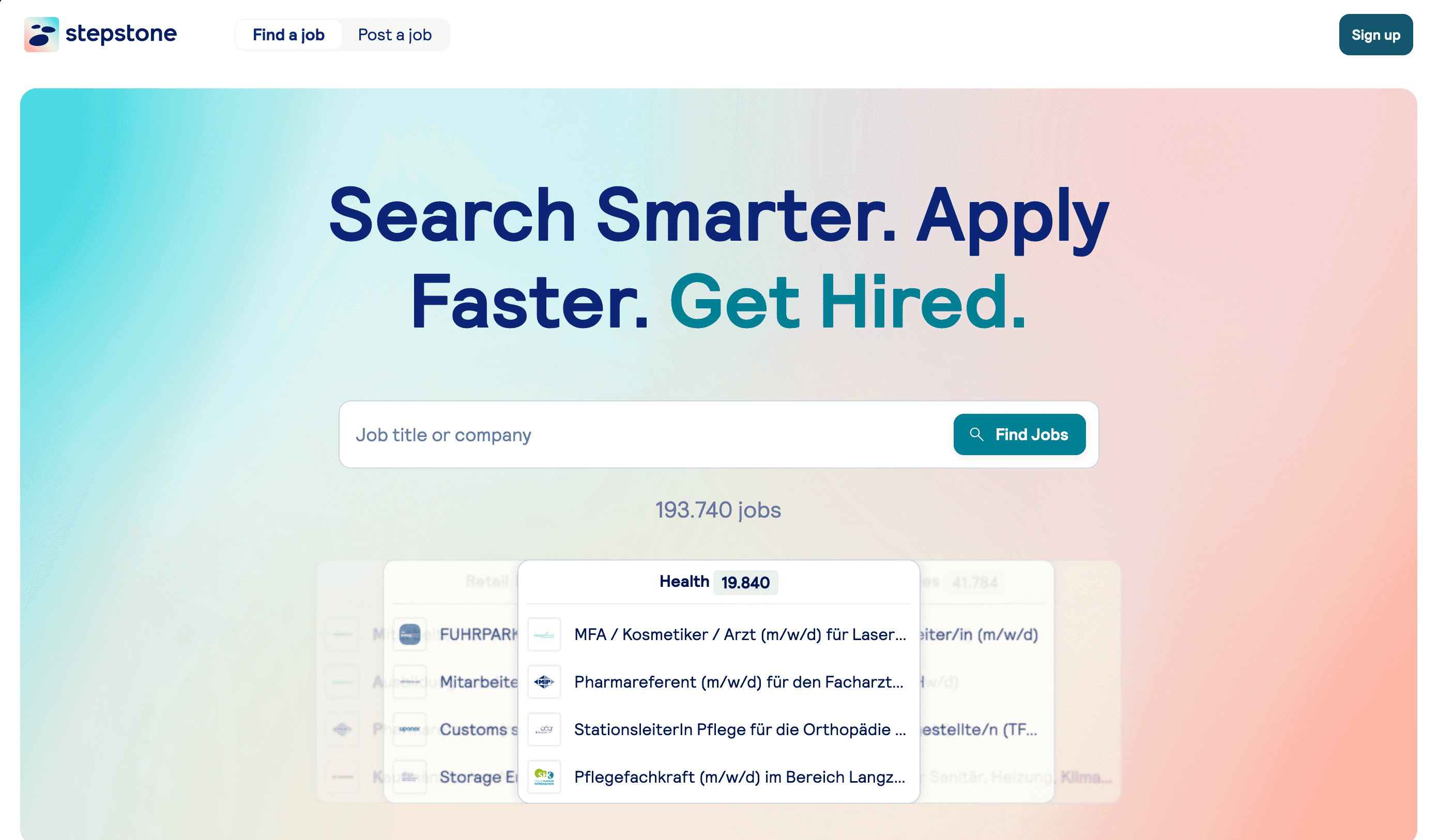
Over 1,100 employment platforms operate in Germany in 2026; Indeed.de and StepStone together cover the majority of corporate listings, while niche platforms like Gulp serve IT contractors.
Where to look for a job in Germany
| Job portal | Description |
|---|---|
| StepStone | This is the main platform for medium and large corporate roles. Its salary tool is essential for checking what you should be earning across different regions. |
| Indeed Germany | It pulls listings from all over the web, which is the best way to find openings at smaller businesses that don’t pay for premium ads. |
| Make it in Germany & Bundesagentur für Arbeit | These are official state portals where employers explicitly want foreign talent and advisors offer career guidance for free. |
| Careerboom.ai | This tool adjusts your CV for local automated HR filters, translates your skills into German terms and helps find open positions and track applciations. |
| Stick to this for tech companies, startups and international brands where English is the norm. | |
| You need a profile here if you want to target traditional local businesses, trades or public sector roles. | |
| Niche platforms | Go straight to Projektwerk or Gulp for IT contracts, and use university career boards for academic roles. |
Pro tip: Send a speculative application (Initiativbewerbung) directly to a department head – German managers respect candidates who take the lead. When you find an open role, apply on the company website instead of using 'Easy Apply' shortcuts, because HR often checks their internal database first.
Need a visa to enter Germany? Check our full guide on German visas here.
Part 2: The German-style CV (Lebenslauf) masterclass
A German-style CV (Lebenslauf) is a 2-page, reverse-chronological document with a professional photo, date of birth, and lückenlos (gapless) employment history. Even if the role is English-speaking, you should stick to German, not UK, standards.
‘The CV/resume is about you, and the cover letter is about them. This means that you can use the CV/resume to shine and sparkle – listing everything about your education, experience, and skills that relate to the position without leaving out any unnatural gaps.’ – German career coach, Jessica Schüller.
Layout and visual structure
- The 2-column format
This is the standard in Germany right now. Keep the design clean and skip the heavy graphics, or the automated HR software (Applicant Tracking Systems) will struggle to read your data.
- Skip the long objective
German CVs don’t need a paragraph about your career goals at the top. If you must have one, keep it to a single sentence. Otherwise, just put your target job title right under your name in large type.
- The professional photo (Bewerbungsfoto)
Legally, you don’t have to include a photo. In reality, roughly 80% of hiring managers still expect to see one. Get a proper, friendly headshot – a cropped holiday photo will hurt your chances.
- Personal details
Including your date of birth and nationality may feel unusual if it’s not a standard practice in your country, but it’s expected in Germany, along with your regular contact information.
Formatting your experience (the 'lückenlos' rule)
Your CV should be lückenlos (gapless), meaning that you need to account for every single month since you finished school. HR teams in Germany check timelines closely.
- Handling gaps: Blank spaces are an immediate red flag. If you took time off, just label it honestly. 'Career reorientation', 'travel', or 'further education' are perfectly acceptable reasons for a gap.
- Position over company: List your experience backwards from your current job. Put your job title in bold, not the company name – they care more about what you did than where you sat.
- Bullet points and numbers: Give five to eight bullet points detailing your responsibilities for each role. Facts work better than strong adjectives here. Instead of writing that you 'improved processes', state that you 'increased efficiency by 15%'.
Categorising your skills
Group your skills logically, for example, into the ‘techincal’, ‘soft’, and ‘language proficiency’ groups. A single block of skills at the end of the page is hard to read.
- Technical skills: Pick around eight that matter for the job, like Python, AWS, or CAD. Match the exact words used in the job advert so the automated software (ATS) recognises them.
- Interpersonal/soft skills: Keep this short. Three skills that relate directly to the role are enough.
- Language skills: Use the official CEFR grading (like A2, B2, C1) to show your level. Put English first, then German. If you are just starting with German, write: 'German: Beginner, currently learning'.
There is no one magical template that will secure you a job in Germany. Try different approaches, analyse what company is looking for and what’s common in your field. We shared some general advice, but the key is to be clear, highlight your value as an employee, and convince a manager to hire you. Be flexible and constantly adjust your CV.
Part 3: The cover letter (Anschreiben)
A strong German cover letter is one DIN-A4 page naming the exact role, mirroring the job advert's keywords, and including salary expectations if asked. Generic templates are easily spotted by recruiters who process hundreds of applications daily and get rejected quickly.
The introduction
Use your first two or three sentences to state why you want the job and what makes you a strong fit. You only have a few seconds before the recruiter moves on, so skip standard phrases like 'I am writing to apply for…'.
For example: 'As a software engineer with five years of experience building SaaS solutions with Python and AWS, your recent announcement about expanding your cloud services caught my attention.'
The main body
This section is about showing you understand what the company needs and how your past work helps them get there. There is no need to repeat your CV.
Look closely at the job advert and pick out the exact technical and personal skills they are asking for. Then, back up those requirements with your own milestones. If they need a problem-solver, explain how your last project management role prepared you for the challenges they are facing now.
The conclusion
Wrap up the letter with clear details on salary expectations and the date you can start working.
- Salary expectations (Gehaltsvorstellung): If the advert asks for your expected salary, you have to include it. Give a specific gross annual range, such as 'My salary expectations are between 62,000 EUR and 65,000 EUR gross per year'.
- Notice period (Kündigungsfrist): State exactly when you can start. Standard German notice periods are often three months, so being available immediately puts you at a strong advantage.
- The sign-off: Close by saying something like, 'I look forward to discussing how I can support your team in a personal interview.' End with the standard formal greeting 'Mit freundlichen Grüßen', and add your signature. A digital signature works perfectly fine.
Part 4: Compiling and submitting your application
A German job application is one PDF in a fixed order: cover letter → CV → certificates (Zeugnisse). Missing documents or wrong file formats are among the top reasons applications are rejected.
- The 'One-PDF' rule: Don’t send multiple attachments. Everything goes into exactly one PDF file if possible and not stated otherwise in the application requirements.
- The importance of Zeugnisse: Claiming a skill isn’t enough, you must prove it on paper. Attach your university diplomas, transcripts, and Arbeitszeugnisse (formal employer references). Without them, traditional companies will simply reject your application as incomplete.
- Avoid 'Easy apply': LinkedIn, StepStone, and Indeed are great for finding roles, but skip their quick application buttons. Apply directly on the company's website. Recruiters always check their internal systems first, so applying directly ensures your PDF is seen.
Explore: Your ultimate guide to taxi, delivery jobs in Germany.

Part 5: Mastering the interview (Vorstellungsgespräch)
German interviews last 60–90 minutes and focus on verified evidence: interviewers expect exact project outcomes, not narratives. German job interviews focus on hard evidence rather than charm.
Punctuality: Arriving 10–15 minutes early is the baseline. Walking in right on the dot often feels late to a local manager, and delays without a solid reason will usually cost you the job.
Direct answers: Expect pointed questions. Skip the long background stories and just give the raw data: the exact problem, your specific actions, and the final numbers.
Questions to avoid: Asking about holidays or overtime makes you look more interested in leaving than working. Ask about the team's strategic goals or the daily challenges you will face instead.
‘Present yourself as a problem solver, not a petitioner… Nothing is as important as the ability to approach people and get into conversation with them.’ – psychologist, career consultant & author, Hans Christian Schrader.
Part 6: Getting your qualifications recognised (Anerkennung)
If your profession is regulated (e.g. doctors), you must get your foreign qualification recognised by the competent authority in Germany. Without getting your papers officially approved by the state you won’t get a work visa and won’t be allowed to do your job.
Regulated versus non-regulated jobs
- Regulated professions: If you work in healthcare, education or safety – like doctors, nurses, teachers, architects and lawyers – the law won’t let you work until the state checks your credentials. Germany has over 400 of these protected jobs, and the rules are strict.
- Non-regulated professions: For software developers, mathematicians or business managers, you don’t need a state license just to do the job. But if you’re a non-EU citizen, the visa office still needs proof that your university degree matches German standards, which you can check in the Anabin database.
Strict rules for translations and certifications
If a single document is missing the right stamp or the required translation to German/English, your entire application may go straight to the bottom of the pile. Local officials won’t compromise on paperwork.
- Keep your original certificates safe at home. The authorities only want to see copies that have been officially stamped and certified as true.
- You must use a state-certified sworn translator to translate your paperwork into German.
Pro tip: Check with the local office before you pay for translations back home. Many German departments refuse to accept translations done by professionals based outside Germany, which means you would have to pay twice.
Processing times, costs and financial help
- Timeline: Expect to wait at least 3 months for a decision once they have every piece of paper (as of 2026). If your case is complicated, it will take longer – so plan your budget around this gap.
- Costs: The review itself usually costs between 200 EUR and 600 EUR in 2026. You need to budget extra for the translation and certification fees, which aren’t included in that price.
- Funding: Usually, you have to cover these expenses yourself. If you are an EU citizen, look up the EURES 'Targeted Mobility Scheme' to see if they can help with the bill. The German Federal Employment Agency also runs specific international projects that sometimes pay these costs if your job is in short supply.
Dealing with gaps and missing documents
If the office decides your degree doesn’t quite match the German equivalent, you can pass local exams, enter training or get extra documents.
- Compensation measures: You can bridge the gap by completing a practical placement, passing a local exam or doing on-the-job training once you arrive in Germany.
- Missing documents: If you had to leave your country in a hurry or lost your original papers, there is still a way forward. For practical trades, Germany lets you do a hands-on skills assessment to prove what you can do in person.
Pro tip: Look into a 'recognition partnership' if you already have a firm job offer. This specific visa route lets you move to Germany and start your job straight away, on the condition that you finish your official paperwork while you are working.
If you plan to send money home after arriving in Germany, download the Profee app. Profee will deliver your money in minutes and with peace of mind, so you can concentrate on your job and life in Germany.
How do I find out if my qualification is recognised in Germany?
- Check whether your profession needs recognition on the 'Recognition Finder'
- If yes, go to the Anabin database and find your institution there.
- If you see ‘H+’, your degree is fully recognised.
What is the best way to find a job in Germany?
Tailor your CV to the German style, use local portals like Indeed and StepStone, and adjust your application for each company. Often the easiest way to get a job in Germany is networking.
Is 3,000 EUR a good salary in Germany?
An average gross salary in Germany was 4,851 EUR in 2025. So no, 3,000 EUR doesn't pass as a good salary.
What jobs are in high demand in Germany?
IT, engineering, healthcare, marketing, HRs, and education as of 2026.
What jobs can foreigners do in Germany?
There are no restrictions to job types that foreigners can and can’t do, as long as it’s legal.