

Visa options for Pakistanis coming to Germany: the full guide

In 2026, Germany has a clear distinction between the two visa types (long-term vs short-term) and five long-stay relocation pathways. Knowing the difference and specific rules is the only way to avoid a ‘Refused’ stamp. So, we’ve prepared the roadmap, covering Schengen visa (Type C), German National visas (Type D), Fachkräfteeinwanderungsgesetz (Skilled Immigration Act) and more. By the end of the article, you’ll know how to actually get your application approved.
Short-term vs Long-term visas
Type D visa pathways (2026)
Visa application guide
FAQ – Applying for a visa
Short-term vs long-term visas
The Auswärtiges Amt (German Federal Foreign Office) distinguishes the visa types based on why and for how long you’re going to Germany.
- Schengen visa (Type C)
Think of the Schengen visa as a ‘visit’ ticket. Type C is for tourism or quick business trips for up to 90 days. In Pakistan, VFS Global Pakistan handles the short-term visa applications submitted through the VIDEX form.
Just a heads-up: You can’t turn a tourist visa into a residence permit; if you want to stay, you have to fly back to Pakistan and apply for a type D visa.
- German national visa (Type D)
When your stay is longer than 90 days, you must get a German National visa. Your application will be handled by the German Embassy in Islamabad or the German Consulate in Karachi and VFS Global. Later, you must obtain an actual residence permit.
Tips: Visas & embassies, guide for Pakistanis moving to Germany.

Type D visa pathways (2026)
As of 2026, five distinct immigration routes exist for Pakistani citizens, managed by the official Make it in Germany portal and BAMF.
Path 1: Employment & work
Visas for workers, freelancers, volunteers and scientists:
| Visa | Details |
|---|---|
| EU Blue Card | For highly qualified professionals. The 2026 salary threshold is approximately €50,700 (Standard) or €45,934.20 (Shortage occupations/New graduates). IT specialists can get this without a degree if they have 3 years of experience. |
| Skilled worker visa | For those with a degree or vocational qualification fully recognised in Germany. Requires educational credential recognition. |
| Visa for professionally experienced workers | For those with a Pakistani degree and 2+ years of experience. Salary must be at least €45,630 (higher if over age 45). |
| Recognition partnership visa | Allows you to work in Germany while completing the educational credential recognition process. |
| Research & scientist visa | For academics with a hosting agreement from a German research institute. |
| Self-employment / freelance visa | Requires a business plan and proof of local economic impact. |
| Au Pair visa | For those aged 18–26 living with a host family. Requires A1 language proficiency. |
| Voluntary service visa | For programmes like VFSJ/BFD. |
Path 2: Opportunity & job-seeking
- Opportunity card (Chancenkarte): Granted based on a point system (6 points required) or recognised qualification. Valid for 1 year; allows 20 hours/week part-time work while job hunting. This is the primary job seeker visa in 2026.
Chancenkarte: Full guide for Pakistanis moving to Germany.
- Job seeker visa: Traditional 6-month visa for recognised degree holders.
Path 3: Study & education
- Student visa: Requires a blocked account (Sperrkonto) with €11,904 on it. Additionally, you may be asked to complete the HEC attestation of your study documents.
- Student applicant visa: 3-9 months for those awaiting admission but needing to take entrance exams.
- Vocational training (Ausbildung) visa: For training in recognised occupations. Requires B1 language proficiency and often pays a monthly stipend.
- Language course visa: For intensive courses (>18 hours/week) lasting over 90 days.
Path 4: Family & private life
- Family reunification visa: For joining a spouse or parent. Spouses usually need A1 language proficiency (unless joining a Blue Card/Skilled worker holder).
- Marriage visa: For entering Germany to marry a resident.
Path 5: Special purpose & other long-stay
- Medical treatment visa: For long-term care. Requires an invitation from a German hospital and proof of funds.
- Professional athletes and coaches’ visa: Requires a contract with a German sports institution and a gross salary of at least €50,700.
- Internship/trainee visa: For students or graduates (within 2 years). Requires ZAV approval and a contract.
There are also special regulations for artists, language teachers, professional drivers and other groups. Head to the Make it in Germany portal to learn more.
Popular visa options in more detail
Most long-term visa applications come from students, skilled workers and those chasing the Chancenkarte:
Note: To see the full requirements and lists of documents, head to the official portals.
- Student visa
The student visa is the classic way to move to Germany, and while it’s a great path to a new life, you need to get through the paperwork first.
The verification process. You might have heard rumours about a mandatory APS Certificate (Academic Evaluation Centre Pakistan). As of April 2026, there is no official word that the APS Certificate is actually required yet. Keep a close eye on the German Embassy and the Make it in Germany portal for any sudden updates.
For now, your real "truth check" is educational credential recognition. If requested by the authority, you need to get your degrees attested by the HEC. You may also check the Anabin database to know whether your education is recognised in Germany. This is how you prove to the authorities that your Pakistani qualifications are the real deal.
Proof of funds: Germany needs to know you can afford to live there. You’ll have to set up a Blocked Account (Sperrkonto) with €11,904 for the year. This equals €992 a month, which is what the government has decided you need to cover your rent, health insurance, and groceries.
- Skilled worker visa
To get the skilled worker visa, you have to prove you are a "qualified professional."
Educational credential recognition: Your Pakistani degree must be recognised as equivalent to a German one. You can check this yourself on the Anabin database. Your degree should have an "H+" status (recognised). If not, you’ll need a Statement of Comparability from the ZAB.
A valid job offer: You should have an official invitation from a German company that meets all the job offer requirements (salary threshold, working hours, etc.)
Salary thresholds (2026): For a standard skilled worker visa, your job needs to pay at minimum €45,630 (or, in some cases, €45,934.20, matching the lower EU Blue Card threshold) per year. The requirements vary between Blue Card and skilled worker visa types, profession and age groups. So, always check your exact case.
Language proficiency: While many tech or international companies only care about English, the visa process often goes smoother if you can show some German language proficiency. Many roles will officially ask for B1 or B2. If your job is entirely in English, make sure your contract or a letter from your employer explicitly says so.
- Opportunity Card (Chancenkarte)
To seek a job while already in Germany.
Eligibility: You need 6 points. Being young (under 35) and knowing some German or English helps a lot.
Benefits: You can work 20 hours a week to pay your bills while searching for a permanent career.
Financial proof: You still need a blocked account showing about €1,091 per month. Germany wants to know you won't run out of money while job hunting.
Type D visas fees & times (April 2026)
| Category | Visa fee | Processing time |
|---|---|---|
| Student | €75 (~24,000 PKR) | 4-12 weeks |
| Skilled worker | €75 (~24,000 PKR) | 6-12 weeks |
| Chancenkarte | €75 (~24,000 PKR) | 3-5 months |
Be aware that the processing time can increase when the mission is at full capacity. For example, if you’d go to the German Foreign Office Consular Services Portal on April 20th, 2026, you’d see this message:
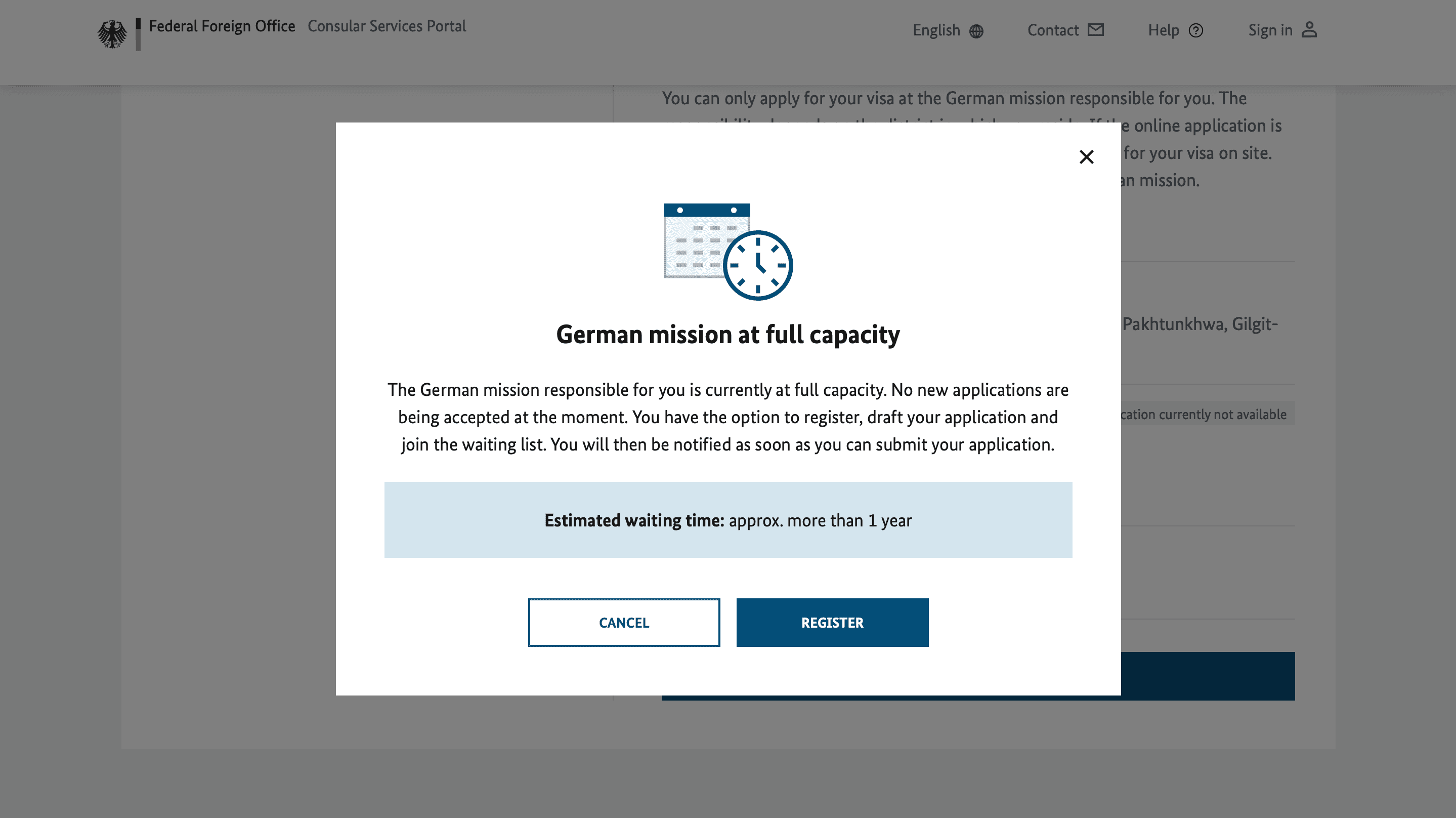
You might need to wait over a year to get a visa. Lesson here? Apply as early as you can.
Visa application guide
You should get through four stages: document preparation, embassy appointment, interview and final decision.
Step 1: Document preparation
The required document set is different for each visa type. Here are a few basic tips:
- Passport: Should be valid for three more months after you leave Germany.
- Language proficiency: Stick to Goethe-Institut, IELTS and other official tests.
- NADRA documents: The Embassy trusts NADRA. Your FRC and Birth Certificate are non-negotiable.
Step 2: Book an embassy appointment
Book an embassy appointment slots via the official Consular Services Portal as soon as they open. Or join the waiting list. If you have a "pre-approval" from the Ausländerbehörde (Foreigners' Registration Office) in Germany, you might get a faster track.
Step 3: Visa interview
Don't just memorise answers. Be ready to explain why you aren't going to the UK or USA and exactly what you'll be doing in your job or course. Be honest and genuine. Learning a few historical and cultural facts can help, too.
Step 4: Wait
A work visa might take 8 weeks, but family cases can take a year. Don't book non-refundable flights until you have the sticker in your passport.
Explore more: Top reasons for Pakistanis to move to Europe
How much is a German visa for Pakistanis?
| Visa | Fee (as of April 2026) |
|---|---|
| Schengen visa | €90 |
| Schengen visa (children age 6 to 12) | €45 |
| Airport transit visa | €90 |
| Long-term visa | €75 |
| Family reunion for children up to 17 years old | €37.59 |
How much money do I need in my bank balance for a German visa?
For a German student visa, you typically need about €11,208 per year (around €934/month), usually shown in a blocked account. For work visas, there is no fixed amount. For job seeker visas, you need €1,091 per month in 2026.
Can I submit a 3-month bank statement for a Schengen visa?
Yes, but not older than 3 months.
Does Germany give citizenship to Pakistanis?
Yes, you can even obtain dual citizenship, starting from January 9th, 2026.
Why can my German visa application be rejected?
- Financial shortfalls: Being even slightly under the Blocked Account (Sperrkonto) requirement of €11,904 or having "unexplained" large deposits.
- Missing or unattested documents.
- The "Intent to Return" doubt: If the officer isn't convinced you’ll return to Pakistan after your stay, they may label you a migration risk.
- Weak motivation letter.
- Salary thresholds: For a work visa, if your pay is even €100 below the €50,700 mark (or €45,934 for shortage roles), it’s an automatic rejection.
- Interview performance: If your spoken language proficiency doesn't match the level on your certificate.