

Yes, you may save money on utility bills (without losing up on comfort)

You can save money on utility bills by choosing efficient appliance settings, checking your tariff, monitoring how much you spend, and making small renter-friendly improvements like LED bulbs or draft stoppers. Whether you’re looking for quick and easy ways to save money on utility bills or longer-term strategies, this guide will help you cut everyday costs without sacrificing comfort.
Understand your utility bills first
You may pay a fixed amount, actual amount or an estimated amount (with a reconciliation later) – depending on the situation, your cost-cutting strategy will change, too.
Ask your landlord:
- Which utilities are included in the rent
- Which are billed separately
- Whether payments are fixed or based on consumption
- How often final settlements are issued
- Whether you can see the underlying bills or meter readings
Find out exactly what you are paying for and whether the bill matches your real consumption. A high bill can come from increased usage, a more expensive tariff, estimated meter readings, or fixed charges that have nothing to do with how much energy you use.
Start by comparing your current bill with the previous month and, if possible, the same month last year.
Check:
- How many kWh of electricity or gas you used
- How many cubic metres of water you used
- The price per unit
- Fixed or standing charges
- Taxes and network fees
- Whether the meter reading is actual or estimated
If your bill increased by 20% but your consumption stayed roughly the same, cutting your usage alone won’t fully solve the problem because the tariff or fixed charges may have changed.
Check whether your meter reading is estimated or actual
An estimated meter reading is calculated by your supplier based on previous or typical consumption, while an actual reading comes directly from your electricity, gas, or water meter. If the estimate is too high, you may overpay; if it is too low, you could face a larger adjustment later.
Check your bill for labels such as “estimated,” “E,” “actual,” or “meter read.” If you have a smart meter, readings may be sent automatically, although estimates can still appear if the connection fails.
To get an actual reading:
- Find the correct meter and check that its number matches your bill.
- Write down the current reading and take a dated photo.
- Submit it through your supplier’s app, online account, website, or customer service.
- Check the next bill to make sure the new reading was used.
This is useful when moving in or out, changing supplier, returning after a long absence, or receiving an unusually high bill.
Check your electricity and gas tariff
A better energy tariff might save you more than small changes at home. If you can choose your electricity or gas provider, check whether another plan costs less based on your usual consumption.
Compare:
- The price per kWh
- Any fixed monthly fee
- Whether the price is fixed or can change
- Contract length and cancellation fees
- Discounts and off-peak rates
You can compare tariffs on your provider’s website or a local energy service. Check again from time to time, especially when your contract is about to renew because the tariff you signed up for may no longer be the best deal.
Work out whether an off-peak tariff helps you
An off-peak tariff is useful only if you can move a meaningful share of your electricity use into cheaper hours. Running one phone charger at night will make almost no difference; moving a dishwasher, washing machine, dryer, electric water heater, or EV charging can.
For example, suppose electricity costs:
- 0.32 EUR/kWh during peak hours
- 0.20 EUR/kWh off-peak
If a washing and drying cycle uses 4 kWh, moving it to the cheaper period saves about 0.48 EUR each time. Do that three times a week and the annual difference is around 75 EUR.
Reduce heating costs without making your home uncomfortable
You can reduce heating costs by lowering the thermostat slightly, heating only the rooms you use, stopping drafts, and avoiding heat loss through windows and doors. Heating is often one of the largest household expenses, so these changes can have a bigger impact than switching off lights or unplugging small devices.
Lower the thermostat slightly
Reducing the indoor temperature by even a small amount can lower heating demand over the entire autumn and winter. Instead of turning the heating off completely, start by reducing the thermostat by around 1°C and see whether the room still feels comfortable. For example, if you normally keep your living room at 22°C, try 21°C.
Bedrooms can often be kept cooler than living rooms, especially overnight.
Avoid dropping temperatures too far in cold weather, though. Very cold rooms can increase condensation and mould risk, particularly in poorly ventilated homes.
Don’t heat empty rooms at the same level
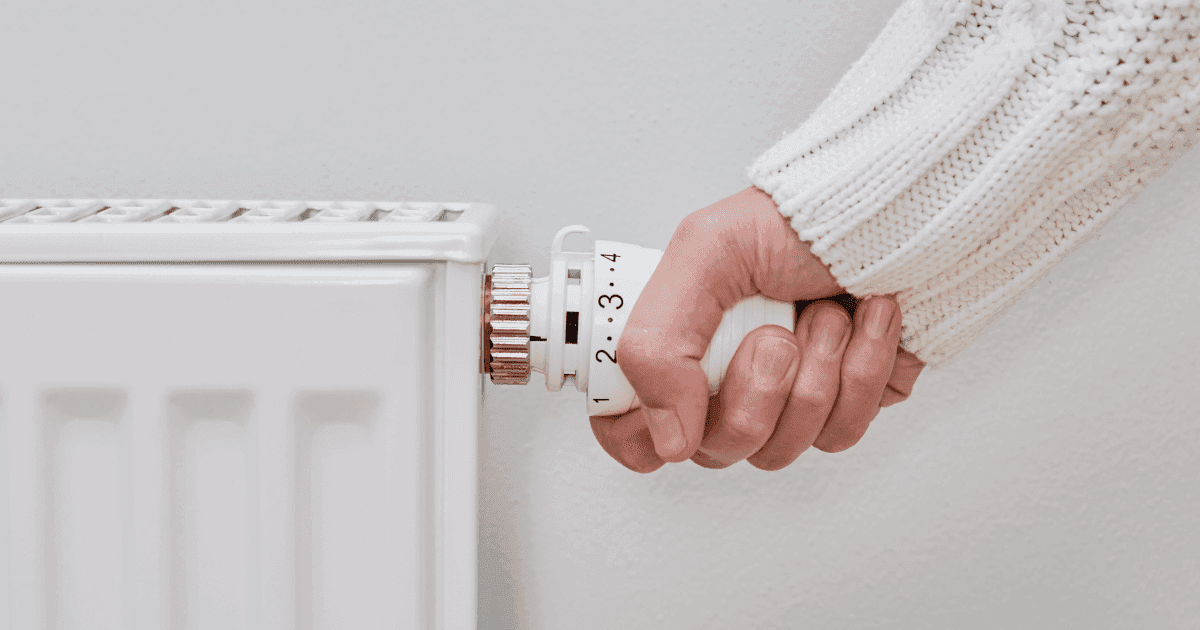
If your heating system has individual radiator controls, lower the setting in rooms you rarely use instead of heating the entire flat equally.
For example:
- Keep the living room comfortable while you are there.
- Use a lower setting in a spare bedroom.
- Reduce heating when you leave for work.
- Don’t heat a hallway to the same temperature as your main living space.
- Turn the heating down before you leave for work.
- Don’t heat a hallway to the same temperature as your main living room.
Make sure your radiator is heating the room, not your sofa
If your sofa is pushed right up against the radiator, or long curtains hang down over it, the heat isn't making it into the room – it's going into the furniture or straight towards the cold window.
Give radiators some breathing room where you can. If your curtains cover the radiator, tuck or tie them back while the heating is on. Once the radiator's cooled down for the evening, close the curtains fully.
Open curtains on sunny days, close them at dusk
On a clear winter day, sunlight through the window adds real warmth to a room, and it costs nothing. Keep curtains open while the sun is out. Once it gets dark, close them. Glass loses heat fast at night, and curtains act as an extra layer of insulation between you and the cold outside.
Thick curtains can help reduce heat loss through older windows, but if cold air is coming in through gaps or damaged seals, ask your landlord to repair them.
Find drafts instead of guessing where heat escapes
On a cold or windy day, slowly move your hand around window frames, balcony doors, entrance doors, letterboxes, gaps beneath doors –you don’t need specialist equipment to find obvious drafts. If you can clearly feel cold air entering, removable weatherstripping or a draft stopper may help.
Don’t cover or seal built-in ventilation openings, even if you feel cold air coming through them. They are designed to remove excess moisture and bring in fresh air; blocking them can increase condensation, mould, and poor indoor air quality.
Use short, intensive ventilation in winter
Leaving a window tilted open for hours can cool walls and furniture while the heating continues to run. A better approach is to open windows fully for a shorter period and then close them again.
For example, rather than leaving a bedroom window tilted all morning, ventilate it properly for several minutes after waking up.
The best method depends on the building and climate, but the principle is simple: exchange stale air without continuously heating outdoor air.
Be careful with portable electric heaters
Portable electric heaters can be expensive because their power use is easy to underestimate: a heater rated at 2 kW consumes 2 kWh for every hour it runs at full power. If your electricity price is 0.30 EUR/kWh:
- 1 hour costs around 0.60 EUR
- 5 hours costs around 3 EUR
- 5 hours every day for 30 days costs around 90 EUR
A portable heater can make sense when warming one small room briefly instead of heating an entire home.
Cut summer cooling costs before using air conditioning
Preventing a room from heating up is cheaper than cooling it afterwards. Close blinds or curtains before strong sunlight reaches the windows rather than waiting until the room is already hot.
A nice summer routine is:
- Ventilate early in the morning while outdoor air is cooler.
- Close windows when outdoor temperatures rise above indoor temperatures.
- Close blinds on sun-facing windows before direct sunlight enters.
- Open windows again in the evening when temperatures fall.
- Use a fan before switching on air conditioning.
Fans use electricity too, but generally cost less than an air-conditioning system. They don’t lower room temperature; they make people feel cooler by moving air.
If you use air conditioning, avoid setting it excessively cold. Cooling a room to 20°C when 24–25°C is comfortable creates additional work for the system.
Use your washing machine more efficiently
Lower-temperature washes and full loads can reduce the cost of doing laundry because much of the energy used by a washing machine goes into heating water. Instead of automatically choosing a hot cycle:
- Use 30°C for lightly soiled everyday clothes when suitable.
- Save hotter cycles for items that genuinely need them.
- Wait until you have a reasonable load.
- Use eco mode when you aren’t in a hurry.
- Choose a high spin speed before air-drying or tumble-drying.
Eco programmes may take longer, but they are designed to reduce water and energy use.
Calculate whether your tumble dryer is worth using
Dryers can be among the most electricity-intensive appliances in a home. If your dryer uses 2.5 kWh per cycle and your electricity costs 0.30 EUR/kWh, one cycle costs around 0.75 EUR in electricity.
To spend less:
- Air-dry clothes when you can.
- Use a high spin speed in the washing machine first, so clothes go into the dryer less wet.
- Clean the lint filter after every use.
- Run full loads instead of drying just a few items.
- Stop the cycle once the clothes are dry.
Run the dishwasher only when it’s worth running
A full dishwasher is usually more efficient than running several partially loaded cycles. Use eco mode for everyday washing and avoid rinsing every plate under hot running water before loading it. Scraping food residue into the bin is usually enough.
If your electricity tariff is cheaper overnight or during certain daytime periods, schedule the dishwasher at these times.

Check your refrigerator settings
A refrigerator runs 24 hours a day, so an inefficient setup can waste electricity continuously. Check that the appliance is cold enough to store food safely but not unnecessarily cold.
Also check:
- The door seals close properly.
- Food isn’t blocking internal air circulation.
- The refrigerator has ventilation space around it.
- Ice hasn’t built up heavily in the freezer.
- You aren’t leaving the door open while deciding what to eat.
If the door seal is damaged and the appliance belongs to your landlord, report it. A refrigerator that can’t maintain temperature efficiently may run much more often than it should.
Find appliances that are quietly using too much electricity
Focus on appliances that use a lot of electricity or stay on for many hours. A plug-in energy monitor or smart plug can show how much electricity a device uses, so you can see which ones are adding most to your bill. Test devices such as:
- Old refrigerators
- Portable heaters
- Dehumidifiers
- Gaming PCs
- Desktop computers
- TVs and entertainment systems
- Heated towel rails
For example, if a device draws 100 watts continuously, it uses:
0.1 kW × 24 hours × 30 days = 72 kWh per month
At 0.30 EUR/kWh, that is about 21.60 EUR per month.
That type of device deserves attention.
Cut hot water costs, not just water use
Shorter showers save water and the energy it takes to heat it. Time yourself once, most people are surprised how much time they spend showering. If your shower runs 12 minutes, try cutting it to 8 or 9. You'll barely notice the difference, but over a month (especially if you live with someone), that's several hours less of hot water running.
If your landlord is fine with it, swap the showerhead for a low-flow model. Water volume drops, pressure stays roughly the same.
Make temporary fixes that work
These are all reversible, renter-friendly and available at most hardware shops:
- Draught stoppers – block cold air coming under exterior doors
- Weatherstripping – seals small gaps around windows and door frames
- Thermal curtains – hold heat in during winter, block sun in summer
- Smart plugs – switch appliances off remotely or on a schedule; most also track what each device costs to run
- Plug-in electricity monitors – show you exactly how much power an appliance draws and what it costs per month
- Timer plugs – cut power to devices automatically at set hours (useful for towel rails, phone chargers, lamps)
- Drying rack – air-dry clothes instead of using a tumble dryer, which is one of the most energy-hungry appliances in any home
Ask your landlord to fix problems you can’t solve yourself
Faulty equipment and structural problems should not become your personal energy-saving project. If the property has an obvious defect, contact your landlord rather than spending your own money trying to compensate for it.
Report issues such as:
- Windows that don’t close properly
- Broken seals
- Malfunctioning heating
- A thermostat that doesn’t work
- Leaking taps
- Running toilets
- A refrigerator that can’t maintain temperature
- Persistent condensation around damaged windows
Document the problem by taking a dated photo of it. If possible, also explain its practical impact. For example, instead of saying “the flat is cold,” say “the bedroom window doesn’t close fully, cold air comes through the gap, and the radiator has to run for much longer to keep the room warm.”

Save money in shared accommodation
Utility-saving tips work only if everyone in the flat follows the same rules. Agree on a few practical habits:
- Keep shared rooms at a certain temperature.
- Lower heating when everyone is out.
- Run the dishwasher only when full.
- Avoid using the dryer for one or two items.
- Turn lights off when the last person leaves.
- Report leaks immediately.
- Split the cost of useful items such as drying racks or draft stoppers.
If one person works from home while others are away all day, discuss utility splitting before it becomes a source of conflict.
Check bills for errors before paying unusually high amounts
An unusually high bill isn’t always proof that you consumed more as it may be a billing mistake or an incorrect estimate.
Check:
- Meter number
- Meter reading
- Billing dates
- Tariff
- Unit price
- Previous payments
- Estimated versus actual readings
Also check that you are not being charged for consumption from before you moved in.
If the figures don’t match your records, contact the supplier or landlord and ask them to explain the calculation.
What’s more?
You can also explore other ways to save money for expats, from managing your budget to buying affordable basic clothing – saving on utilities is only one way to make living abroad more affordable.
Pro tip: check how much you pay when sending money abroad too.
When comparing international transfers, look at:
- The exchange rate
- Transfer fees
- The final amount your recipient gets
With Profee, you can see the exchange rate, applicable fee, and amount to be received before confirming a transfer. Fees start from 0%, depending on the destination and transfer conditions.
Check your Profee transfer before sending.
FAQ: Cutting utility bills
Does turning off lights really save electricity?
Yes. If you are leaving a room, turning the lights off saves electricity, especially if they would otherwise stay on for a long time.
Is it cheaper to turn off lights or leave them on?
It’s cheaper to turn them off when you don’t need them. With modern LED bulbs, switching them on again uses almost no extra electricity.
What is the 30-minute heating rule?
It means turning the heating on shortly before you need the room instead of leaving it on all day. Around 30 minutes can work in some homes, but the right timing depends on how quickly your home warms up.
Is 24°C too hot for a house?
For many people, 24°C is quite warm for winter and can push heating bills up. Around 19–21°C is often comfortable for living rooms, but it depends on personal preference.
What temperature should I keep the AC on?
Around 24–26°C is a good starting point for many homes in summer. Setting it much lower usually costs more without making a big difference in comfort.