
New euro banknotes: what expats in the EU need to know

Euro banknotes are getting their first full redesign since they entered circulation in 2002. The European Central Bank, or ECB, has shortlisted 10 possible designs and is asking the public which ones they prefer.
Here is what you need to know as an expat about the new designs, what will happen to current banknotes and how to take part in the public survey.
Why wave goodbye to the old euro notes designs?
Beethoven or birds? The two new themes
What happens to your current cash?
When will the new notes arrive?
How can you have your say today?
FAQ about new euro banknotes 2026
Why wave goodbye to the old euro notes designs?
The ECB wants the new euro notes to be safer, easier to use and more relevant to people living in Europe today.
Better protection against fake notes
The new banknotes will include updated security features, making them harder to copy and easier to check.
Technology keeps changing, so central banks regularly improve their banknotes to stay ahead of counterfeiters. The exact security features will be chosen later, once the final design is selected. The future euro notes should be easier for both people and machines to check.
More sustainable euro notes
The ECB also wants the new notes to last longer and have less impact on the environment.
Most likely, EBC will use more sustainable materials and improve the way banknotes are made. If notes stay in good condition for longer, fewer replacements will be needed. Durability is therefore expected to be an important feature of the new euro banknotes.
Easier to recognise and use
The redesign should make euro banknotes easier to tell apart and handle, especially for blind and partially sighted people.
The ECB will look at features such as contrast, large numbers, tactile markings and clear differences between denominations. The final details haven’t been announced yet. These changes should make the new euro notes more practical for everyday use.
A design that feels more European
The ECB also wants the new notes to show European culture and nature more clearly. Current euro banknotes follow a broad topic called “Ages and Styles”. They show bridges, windows and doorways inspired by different periods of European architecture.
The landmarks on the notes aren’t real. The original designers used imaginary buildings and bridges so that no single country would be given more attention than the others. The new euro banknotes 2026 shortlist replaces these imaginary structures with people, wildlife, landscapes and shared cultural spaces.
“The euro is more than a currency – it symbolises European unity and diversity.” – ECB President Christine Lagarde.
Beethoven or birds? The two new themes
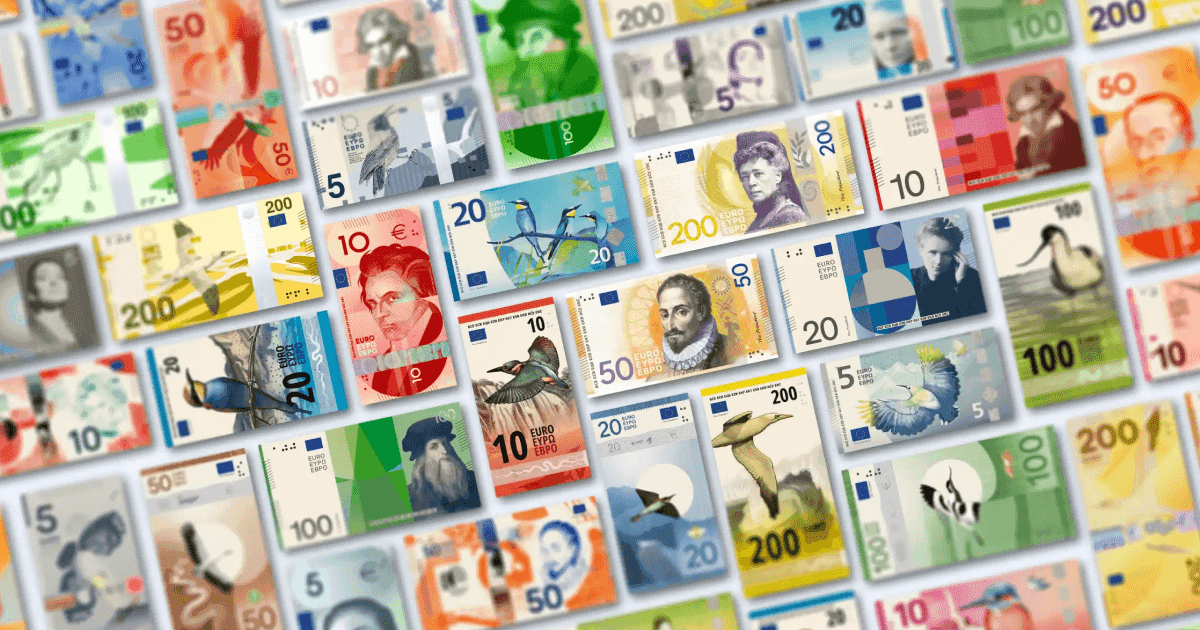
The next euro banknotes will follow one of two themes: “European culture” or “Rivers and birds”.
The ECB chose these themes after speaking to experts and collecting opinions from more than 365,000 people in an earlier survey. It then opened a design competition. In total, 1,241 designers applied, 25 were selected to continue, and they submitted 39 proposals. An independent jury then chose 10 finalists: five for each theme.
The people, birds and institutions linked to each denomination are already set within each theme. What changes from one proposal to another are the style, layout and overall look.
Theme 1: European culture as shared cultural spaces
This theme pairs well-known European figures with places where people experience culture together.
The proposed banknotes include:
- 5 EUR: Greek opera singer Maria Callas, with street performers
- 10 EUR: German composer Ludwig van Beethoven, with children and young adults singing at a music festival
- 20 EUR: Scientist and Nobel Prize winner Marie Skłodowska-Curie, with a teacher and students
- 50 EUR: Spanish writer Miguel de Cervantes, with a library
- 100 EUR: Italian artist, inventor, and scientist Leonardo da Vinci, with adults and children looking at art
- 200 EUR: Writer and peace activist Bertha von Suttner, with people gathering in a tree-covered public square
These people will appear on the new euro banknotes only if the “European culture” theme wins.
Theme 2: Rivers and birds as resilience in diversity
This theme combines European landscapes and native birds with major EU institutions.
The proposed banknotes include:
- 5 EUR: A wallcreeper beside a mountain spring, with the European Parliament
- 10 EUR: A kingfisher near a waterfall, with the European Commission
- 20 EUR: A colony of bee-eaters beside a river valley, with the European Central Bank
- 50 EUR: A white stork flying over a river, with the Court of Justice of the European Union
- 100 EUR: An avocet over a mudflat, with the European Council and the Council of the European Union
- 200 EUR: A northern gannet flying over ocean waves, with the European Court of Auditors
A bold leap in design
The 10 shortlisted designs look very different from one another, ranging from familiar portrait-style notes to much more unusual layouts.
Some designers have experimented with the direction of the notes. Four proposals, for example, use a vertical layout.
- French designer Isabelle Daëron combines hand-drawn felt-tip patterns with digital graphics to show birds, water and movement. “Movement is at the heart of this proposal,” – Isabelle Daëron.
- Greek designer Myrsini Vardopoulou uses more symbolic shapes and cultural spaces instead of focusing only on detailed portraits.
- Studio Joost Grootens places strong attention on eyes and mouths to represent looking, speaking and expression, while the reverse sides show different cultural spaces.
When voting for the new euro banknotes, you are not only choosing between culture and nature – you’re choosing between very different visual styles.
What happens to your current cash?
Your current euro banknotes will keep their value and continue to be used when the new series arrives.
You don’t need to exchange cash kept at home, in your wallet or for future travel. The change will be gradual, and old and new notes are expected to circulate at the same time.
If the ECB ever decides to stop using an older series as legal tender, it will announce the change well in advance.
The ECB also plans to keep the same denominations:
- 5 EUR
- 10 EUR
- 20 EUR
- 50 EUR
- 100 EUR
- 200 EUR
The main colours and sizes are also likely to remain similar to make it easier for people to recognise the notes and reduce the number of changes needed for ATMs, vending machines and other cash-handling equipment.
However, these details are not final yet.
When will the new notes arrive?
The new euro banknotes are still several years away, and there is no official launch date yet.
The ECB is expected to choose the final design around the end of 2026. It will look at the public survey results, the jury’s opinion and whether each proposal can work as a real banknote.
After that, the chosen design will need to be turned into a secure and practical banknote series. The ECB will work on materials, security features, printing, accessibility and how the notes work in ATMs and other machines.
Testing and production will take several years, so the new notes won’t appear immediately after the winner is chosen.
How can you have your say today?
Anyone can take part in the ECB’s online survey, no matter their nationality, age or country of residence. This includes expats living in the euro area, elsewhere in the EU, and people outside Europe.
The survey is open until 21 September 2026 at 23:59 CET. You can view all 10 shortlisted designs, read what the artists say about them and choose your favourites on the ECB’s survey website.
The public vote will not decide the winner by itself. The ECB will also consider a separate survey among people in the euro area, the jury’s feedback and technical checks.
So, whether you would rather see Beethoven on a 10 EUR note or a white stork on a 50 EUR note, you can still have a say in what the future euro may look like.
This article, including the images used in it, is intended solely for informational, editorial and news-reporting purposes and is not commercial or promotional in nature. The images may not be used for commercial, promotional or merchandising purposes, altered or presented in a misleading manner, or used in any way that suggests endorsement by the ECB or the Eurosystem without the ECB’s prior written authorisation.
FAQ about new euro banknotes 2026
Are old 50 euro notes still valid in 2026?
Yes, they are fully valid.
Are any euro notes out of date?
No. The original 2002 series, the Europa series and future redesigned notes remain valid.
Are euro notes the same in every country?
Yes, the euro note design is the same. With euro coins, things are different – each country has its own design.
Who are the people on the new euro banknote?
Greek opera singer Maria Callas, German composer Ludwig van Beethoven, scientist and Nobel Prize winner Marie Skłodowska-Curie, Spanish writer Miguel de Cervantes, Leonardo da Vinci, writer and peace activist Bertha von Suttner.
Is there a 1,000 euro note?
No, there is no such note.