
The ultimate guide to Elterngeld in Germany (2026)

Welcoming a new baby is a magical time, but it also brings big questions about money and work. In Germany, the government supports families through a parental leave benefit known as Elterngeld (Parental Allowance). This guide explains everything you need to know about the Elterngeld in Germany in 2026.
Elterngeld eligibility
Most parents living in Germany are eligible for the parental allowance. To receive it, you must meet basic rules:
| Criteria | Description, as of 2026 |
|---|---|
| Live together | You and your child must live in the same house in Germany. |
| Care for the child | You must be the primary person looking after your baby. |
| Working hours | You can work, but no more than 32 hours per week during the months you receive the benefit. |
| Taxable income ceiling (in the year before the birth) | 175,000 EUR: If your child was born after April 1st, 2025. This limit is the same for both couples and single parents. 200,000 EUR: If the birth was between April 1st, 2024 and March 31st, 2025.250,000 EUR for single parents and 300,000 EUR for couples: For births up to March 31st, 2024.If your income was higher, you are not eligible for Elterngeld in Germany. |
| Legal right to stay in Germany | German citizens, citizens of EU/EEA countries, and Swiss nationals are eligible. Non-EU nationals who hold a settlement permit, a permanent EU residence permit, an EU Blue Card, or a residence permit that entitles them to work. |
Other German family benefits:
Three types of Elterngeld
The Bundeselterngeld- und Elternzeitgesetz (BEEG) provides three ways to receive your benefit: Basiselterngeld, ElterngeldPlus, and Partnerschaftsbonus. You can even mix and match them!
As Lisa Paus, the Family Minister, said: "Especially in the period following the birth, it is important that parents have time for each other and the baby."
Basic parental benefit (Basiselterngeld)
Basiselterngeld is a classic parental leave benefit when one parent can take up to 12 months off work. The benefit is paid only until your child turns 14 months old.
If both parents take at least two months of leave and lose income, the total time increases to 14 months (‘12+2 month rule’). Here’s how parents often split months between each other:
- Mother takes months 1–12, and father takes months 13–14.
- Both parents take 7 months each.
Limitation: If you and your partner want to take Basiselterngeld at the same time, you can only do so for one month within the first 12 months of the child's life. Taking Basiselterngeld together for two or more months is not allowed.
If you want to be home together longer, one parent can take the basic benefit, while the other trades their basic months for a flexible parental benefit (ElterngeldPlus).
Flexible parental benefit (ElterngeldPlus)
ElterngeldPlus is an extended version of Basiselterngeld – you receive payments for 24-28 months instead of 12-14 months. The amount of monthly payments is cut in half, but the total sum stays the same.
If you work part-time (up to 32 hours), a "Basic" check is often reduced because you are earning money. However, with ElterngeldPlus, your monthly payout often stays the same even with your salary. This means you could end up with more money overall while staying in your parental leave period (Elternzeit) for longer.
You can receive ElterngeldPlus until your child is 2 years and 8 months old. Don’t question why not 3 years, let’s just accept the reality as it is.
Partnership bonus (Partnerschaftsbonus)
The partnership bonus (Partnerschaftsbonus) is an extra reward. If both parents work part-time (between 24 and 32 hours per week) at the same time for at least two months, you both get an extra four months of support. Partnership bonus is available even for single parents, given that they work 24-32 hours per week.
Receiving ElterngeldPlus is possible until your child is 2 years and 8 months old.
In short:
| Best for… | Duration | |
|---|---|---|
| Basiselterngeld | Parents who stay home full-time. | Up to 12-14 months. |
| ElterngeldPlus | Parents who want to work part-time. | Twice as long as Basic, but half the amount paid monthly. |
| Partnerschaftsbonus | Parents sharing work and care 50/50. | 2 to 4 extra months of ElterngeldPlus. |
All rules may change over time, verify the details on official sources (familienportal.de, BMFSFJ, handbookgermany.de and others).
Amount of Elterngeld
The amount of your parental allowance depends on your average net income and falls between 300 EUR and 1,800 EUR as of 2026. The BMFSFJ (Federal Ministry for Family Affairs) calculates the average based on your earnings in the 12 months before the birth.
You generally get about 65% to 67% of your previous net income, but no less than 300 EUR and no more than 1,800 EUR per month (150-900 EUR for ElterngeldPlus). So everyone receives at least 300 EUR (or 150 EUR).
"We want people to be able to choose family – if they want – and count on reliable support." – German Family Ministry spokesperson, 2025.
Little trick: The German tax system looks only at the common household income, not your personal ones – use it to your advantage. Since Elterngeld is calculated based on the net income shown on your paycheck, the parent who will take the longest leave should switch to Tax Class III (Steuerklasse 3). Class III reduces taxes, making your "Net" look higher. Don't worry about the partner paying more tax in Class V; you may get that money back in your annual tax return anyway. Remember to switch at least seven months before the leave begins.
Additional bonuses
Depending on your situation, you may request a sibling bonus, a multiple birth bonus or a premature births bonus:
- Sibling bonus: Your Elterngeld increases by 10% (at least 75 EUR for Basic and 37.50 EUR for Plus) if you have another child under 3, two other children under 6, or a disabled child under 14 living in your household.
- Multiple birth bonus: For twins, triplets, etc., you get 300 EUR (150 EUR) per extra child.
- Premature births: If your baby is born prematurely, you receive extra months of Basic Elterngeld. You get 1 extra month if born at least 6 weeks early, 2 months for 8 weeks early, 3 months for 12 weeks early, and 4 extra months if born at least 16 weeks early.
If you’re an expat in Germany and have a family back home, you can support them with safe and secure transfers with Profee. We’ll deliver your care to one of the 90+ destinations any day of the month, without tiring waits.
Application process
Application deadlines
Elterngeld in Germany is only paid retroactively for three months. If you apply when your baby is four months old, you will lose the money for the first month. Benefits aren't paid by the calendar month (like January or February). Instead, the benefits are calculated based on your child's months of life. If your baby was born on the 12th, your ‘Elterngeld month’ runs from the 12th to the 11th of the next month.
Where to submit
You apply at your local Elterngeldstelle (Local Administration Office). While every federal state has its own office, most now use the ElterngeldDigital portal. The platform, supported by the BMFSFJ, guides you through the process and also shows how to combine Basiselterngeld and ElterngeldPlus.
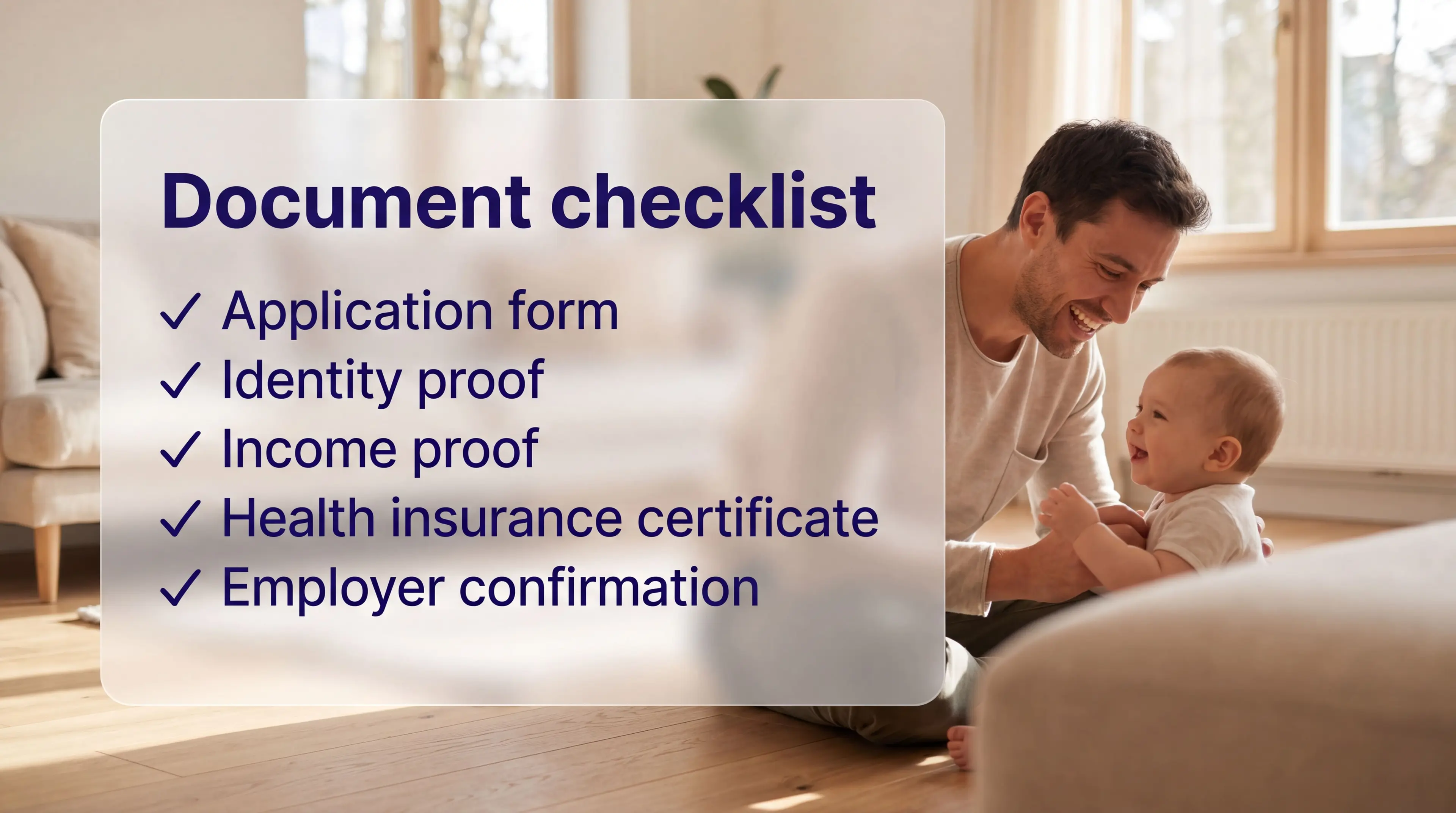
Document checklist
Document list may change, but some basic papers are a must:
- Application form: Forms differ between states, find yours on familienportal.de.
- Birth certificate: You need the original version specifically marked "for Elterngeld" (Geburtsbescheinigung für Elterngeld).
- Identity proof: A copy of your ID or passport. Non-EU citizens must include their residence permit.
- Income proof: Payslips from the 12 months before birth. For self-employed parents, the tax assessment from the previous year. You must share all streams of income you’ve had.
- Health insurance certificate: Proof of your maternity benefit (Mutterschaftsgeld) from your provider.
- Employer confirmation: A letter confirming your parental leave period (Elternzeit) and any maternity subsidies they pay you.
Application steps
- Notify your employer: Submit a written notice for your parental leave period at least 7 weeks before it starts. Get a written confirmation from your company; you’ll need it for your application.
- Collect other documents: Birth certificate (marked "für Elterngeld"), your ID/passport, 12 months of payslips, proof of your maternity benefit, and so on.
- Submit documents (within 3 months): Use ElterngeldDigital to apply online or send papers to your local Elterngeldstelle.
- Wait for the decision: You will receive a notice of the amount and duration of the parental allowance.
- Get the benefit: The parental allowance is sent to your bank account monthly.
Elterngeld eases financial burden and helps parents spend more time with their child. While the amount is not enough to fully rely on, getting some extra cash is never a bad idea, especially, when you don’t plan to work anyway.
All rules may change over time, verify the details on official sources (familienportal.de, BMFSFJ, handbookgermany.de and others).
How much is Elterngeld in Berlin?
In Berlin, as everywhere else in Germany, Elterngeld is 300-1,800 EUR monthly (in 2026). The amount of the benefit isn’t affected by the city you live in.
What if I start a new job while receiving Elterngeld?
Your new salary will affect the amount of Elterngeld you receive – it’ll make it lower. Remember that you can work only part-time (up to 32 hours per week) to stay eligible.
Is Elterngeld taxed in Germany?
Parental allowance is tax-free. However, you should include Elterngeld in your tax return, which increases the tax rate.
Can self-employed parents receive Elterngeld?
Yes, if they will work less than 32 hours per week.
Who pays parental allowance in Germany?
Elterngeld is paid by the German federal government, not by employers. When you have any questions, ask your local Elterngeldstelle, not your boss, who is not responsible for the payments.