Comprehensive guide to Kinderzuschlag (KiZ) for 2026

If most of your salary goes on groceries, transportation, rent and utilities, and little is left for your child, you may be eligible for Kinderzuschlag in 2026. KiZ – or the child benefit supplement – is a German programme that eases financial pressure on working parents, so they can treat their children right. Here is exactly how KiZ works in 2026, who qualifies, and how it can give your family budget some much-needed breathing room.
What is Kinderzuschlag in 2026?
How much money do families get?
Do you qualify?
What is the financial assessment?
Are there extra perks?
How can families apply?
What is Kinderzuschlag in 2026?
The Kinderzuschlag is a monthly financial top-up paid to working parents. It is legally grounded in the Bundeskindergeldgesetz (BKGG) §6a with a specific purpose: to support families who struggle to cover the full cost of a growing family.
The programme is structured so that you don’t have to apply for Bürgergeld (Citizen's Allowance). While Bürgergeld is a full support system from the Jobcenter, KiZ is a ‘top-up’ from the Familienkasse (Family Benefits Office). KiZ acknowledges that you are already earning an income and simply gives you the extra boost needed to cover your children’s needs.
Take on the German social policies: ‘The Federal Government had ambitious plans but had already achieved a great deal. In the area of social policy, for example, the statutory minimum wage has been raised, housing benefit has been increased, the citizen’s allowance has been introduced, child benefit has been increased, the child supplement has been expanded, and a stable pension level has been ensured.’ – Federal Chancellor Scholz, August 20th, 2023.
How much money do families get?
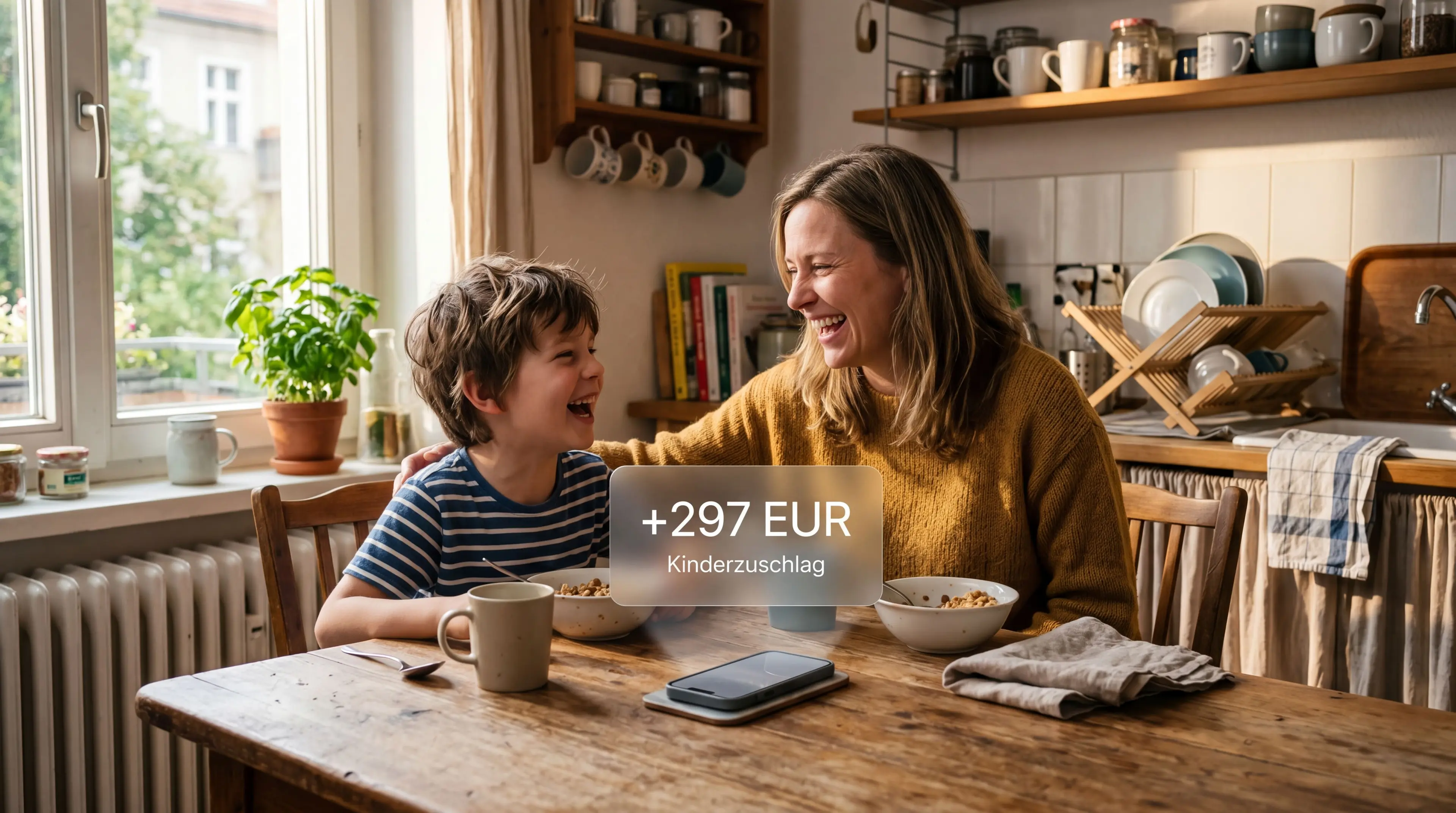
For 2026, the KiZ monthly maximum amount is up to 297 EUR per child, per month. The monthly benefit amount is paid directly into the same bank account where you receive your Kindergeld, so you get all your family support in one deposit. If you have multiple children, this supplementary child allowance can add hundreds of euros to your household budget every month.
More for families in Germany:
Do you qualify?
The Bundesagentur für Arbeit (Federal Employment Agency) has a few eligibility criteria:
- You receive Kindergeld: You must already be getting the basic child allowance for the child in question.
- Child’s age and living situation: Your child must be under 25, unmarried, and living in your household.
- Your income: You must meet a Mindesteinkommen (minimum income threshold). This is set at 900 EUR gross per month for couples and 600 EUR gross for single parents.
- The upper income limit: There is no fixed Höchsteinkommen (maximum income threshold for KiZ eligibility). Instead, your family income assessment depends on your housing costs, your children's ages, and your total earnings.
- Benefit interaction: You cannot receive KiZ if you are currently getting Bürgergeld. However, it works well with Wohngeld (Housing Benefit). In fact, combining KiZ and Wohngeld is the standard way many families get their financial independence.
Quick check: Before gathering documents, use the KiZ-Lotse (an online eligibility check tool by Bundesagentur für Arbeit). Answer a few basic questions and find out if it’s worth applying.
We collected the eligibility criteria on May 14th, 2026. The requirements may change over time, so even if you can’t apply now, keep an eye on the official updates.
What is the financial assessment?
When you apply, the Familienkasse runs a calculation called means-testing. Here is how your money is assessed:
- For parents: If you earn more than what you personally need to live, only 45% of that extra income is offset against the supplementary child allowance. You keep the other 55%. This ensures that working more always results in more money for your family.
- For children: If your child receives money (like a training allowance or maintenance payments), 45% of that amount is offset against their specific 297 EUR child benefit supplement.
Example: If your child earns 100 EUR at a part-time job, 45% (45 EUR) is deducted. Instead of 297 EUR, you receive 252 EUR for that child.
Are there extra perks?
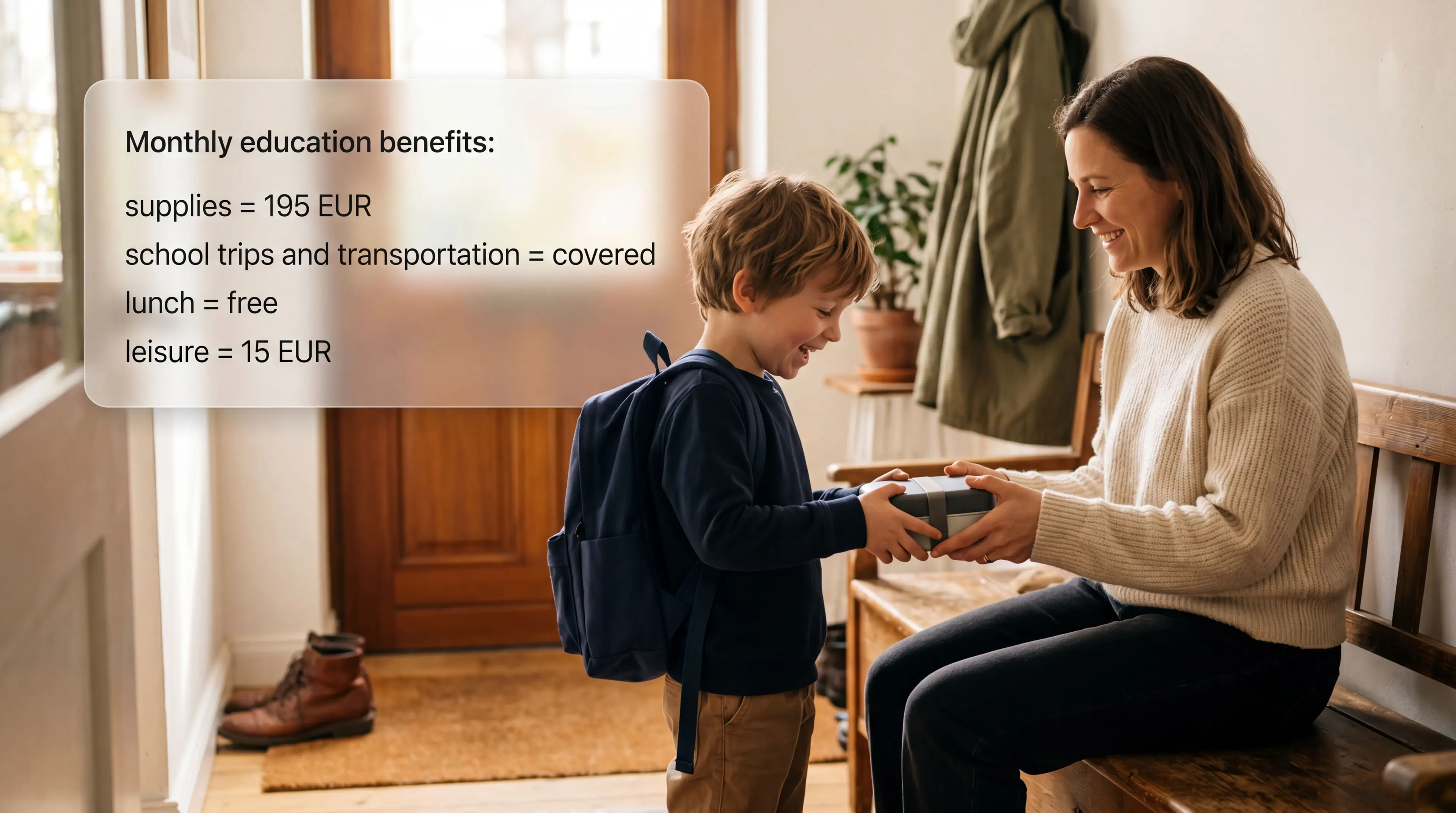
Getting approved for Kinderzuschlag in 2026 automatically triggers access to the Education and Participation Package (Bildungspaket). Extra benefits waive several child-related expenses:
- Daycare and Kita fees: You are entirely exempt from paying regular attendance fees.
- School supplies: You receive 195 EUR per school year, per child for notebooks, bags, and materials (130 EUR paid in the first half of the year, 65 EUR in the second half).
- School trips and transportation: The costs for school transport, class excursions and day trips are covered in full.
- Free lunch: Your children get free hot lunches at school or daycare.
- Higher education support: 1,000 EUR to enrol in the university for the first time.
- Leisure: You get a 15 EUR monthly voucher per child for sports clubs, music lessons, or youth organisations.
As of 2026, the support may be different in the upcoming years.
How can families apply?
The benefit application process is entirely digital and secure.
Step 1: Eligibility check. Before you look for a single document, use the KiZ-Lotse. The tool will tell you in about 5 minutes if your income falls within the right range.
Step 2: Set up your BundID. To apply online (which is much faster), you need a BundID. Use your electronic ID card or a Tax Elster certificateю
Step 3: Collect documents
- Application forms for Child allowance
- Income proof from the last 6 months
- German ID/residence permit
- Pension certificate
- Parental allowance notification
- Notification of pension
- Notification of parental allowance
- BAföG notification
- Proof of maintenance
- Notice of housing benefit (if applicable)
- Proof of the housing costs
- Child's details (tax ID and proof of any income they have).
Some documents are optional, you’ll see the full list once you start filling in the application.
Step 4: Apply online at kiz-digital.de. The portal is interactive; it will skip questions that don't apply to you. You can upload your documents directly as PDFs or clear photos.
Step 5: Repeat after six months. Once approved, you’ll receive your monthly benefit amount for six months. In the 5th month, you should submit a "Short Application" (Kurzantrag) to keep the payments coming without a gap.
You can apply offline as well. In this case, send paper versions of forms and proofs to your Familienkasse (enter your postal code here to know which Familienkasse is yours). Later, you’ll receive an answer – telling you whether you’re eligible or not – by post.
When is Kinderzuschlag paid?
The payment schedule is based on your Endziffer (the very last digit of your Kindergeldnummer). Digits 0 and 1 are paid out during the first week of the month, digits 2 through 5 – somewhere in the middle of the month, and digits 6 through 9 always arrive during the final third of the month.
You can find the exact daily schedule for the entire year directly on the official Bundesagentur für Arbeit Payment Portal.
How long can you receive Kinderzuschlag?
You get the money for six months at a time. If you are still eligible and need financial help after the period, you can renew it for another six months. You can repeat the circle until your child is 25 years old.
Can foreigners or expats in Germany apply for Kinderzuschlag?
Yes, absolutely. If you are an EU citizen, or a non-EU citizen with a valid residence and work permit, your family has the exact same right to this support as German citizens.
Is Kinderzuschlag taxable?
No, Kinderzuschlag is completely tax-free and will not increase your income tax rate. However, you may need to report the benefit on your tax return.
Can single parents receive Kinderzuschlag?
Yes. The government makes it easier for you to qualify by setting a lower minimum income rule, as you only need to earn at least 600 EUR gross per month to apply (as of 2026).
As Lisa Paus, Germany's Federal Minister, said: ‘Children must not be a poverty risk! We thereby place a special focus on single parents.’ (the 68th session of the UN Commission on the Status of Women, New York City, March 2024)